Are Reusable Products that Much Better?

As fears of global warming sweep the world, many have attempted to find ways to become more environmentally friendly and reduce negative environmental impact. This includes new reusable products that supposedly have less of an environmental impact than single use products. It is no new discovery that single use plastics products are a huge contributor to waste of this planet. Two of these products that are currently very popular are reusable straws and reusable shopping bags. I aimed to compare the environmental impact of single use plastic bags and straws compared to the impact of reusable bags and straws.

In 2017 plastic production for the year reached 348 tons, an all time high. As plastic production increases, plastic waste also increases, resulting in more plastic ending up in the environment after being discarded. Much of this is ending up floating around in the ocean. “It is now believed that there are 5.25 trillion pieces of plastic debris in the ocean. Of that mass, 269,000 tons float on the surface, while some four billion plastic microfibers per square kilometer litter the deep sea.” (Plastic Crusaders). With these statistics we are able to see the massive amount of plastic ending up in the ocean, which can be detrimental to some marine ecosystems. Many types of plastic products such as plastic bags and straws can release toxins into the environment that are harmful to ecosystems. Both of these products are big contributors to plastic waste ending up in the environment. There are certain areas of the ocean that are unlivable for organisms because of the high toxicity of the water due to plastic waste. Continuing to produce and discard plastics as we are now could result in more of these areas. With all of this information, it is easy to see why we have to become more environmentally conscious and why reusable products are becoming increasingly popular. 

Compared to single use plastic bags, reusable bags have less of a negative environmental impact after they are made. They are less likely to end up in the environment where they can cause harm. However both have negative impacts when being created, and many types of reusable bags take more energy to create and more carbon emissions are released when they are being made. “For example, the production of paper bags uses four times as much energy as the production of plastic ones. In general, more greenhouse gases are emitted during the production of paper products than their plastic counterparts.” (GetGreenNow). This quote gives some insight into how much more of an environmental impact paper bags have compared to single use plastic ones. Some of the reusable bags can be recycled and some are biodegradable which is a plus. The reusable bags must be used many times before they are actually more beneficial that just using single use plastic bags. Most reusable shopping bags must be used about 134 times before the environmental impact is reduced.So in conclusion reusable bags can be more eco-friendly compared to single use plastic bags, but it is really dependent on how much it is used. Though during the creation process, the reusable bags do have a worse environmental impact.

Since so many reusable straws are thrown out every single day, some reusable straws are a better option. They are very durable and last for a long period of time. The bamboo straws really do their jobs as they are all natural and do not really have any negative environmental impacts. In contrast, some of the other types of straws have negative environmental impacts when being made such as the paper straws and metal straws. Paper straws require more energy and material to make compared to plastic straws. Since paper straws are also single use, they are not much better than the plastic straws. They have a worse environmental impact when being made, but they do decompose at a faster rate than plastic straws, which lessen their negative impact. Metal straws also require much more energy to be created compared to plastic straws. The energy used to create just one metal straw is the same amount that would be used to make 90 plastic ones and the creation produces the carbon emissions of 150 plastic straws. So in this case the metal straw would have to be used over 150 times before it is considered “better” to use than plastic straws. Silicone straws have one main negative, they are colored using dyes that can be harmful to your health.  So similar to reusable plastic bags, for many reusable straws to be more ecofriendly than single use plastic straws, they have to be used many times. Although, some reusable straws such as the bamboo straws are all natural, so in these cases the straws are much better for the environment because they biodegrade easily.  

Social Medias Effect on the Brain

With almost everyone you meet, whether you’re at a party or meeting friends of friends, they will most likely give you their Instagram username rather than their phone number. Instagram and other social media apps have become the main source of networking amongst young adults, especially in the United States. But have these fun, lighthearted apps become detrimental to the mental health of its users?

Instagram has recently been under fire for how the creators organized the application to make it addictive and harmful to the human brain. For instance, the app will alert you when you receive a new like, comment, or follower. When this happens, the brain releases the “happy hormone”, also known as dopamine. This chemical response to the notification causes the brain to constantly crave this feeling when dopamine is released, therefor getting these users to check up on the app more frequently, till it becomes a daily or even hourly habit.

Another issue that Instagram has been dealing with is the backlash from people saying that receiving a number of likes causes users to subconsciously compare themselves to others on the app, turning Instagram into a competitive playground where people feel as though they cannot be themselves with the chance that they won’t get as many likes. Due to this, an idea has been in the works to remove the number of likes off of posts to create a more positive environment on the app.

Young adults whose minds are not fully developed yet will have a larger response when effected by outside stimuli. This meaning, when a 14 year old girl sees beautiful “Instagram Model” on her feed receiving many likes or comments, she begins to contemplate if her looks are good enough. This comparison to others on social media has people not only judging themselves, but thinking that their life is insignificant.

But the truth is, Instagram is anything but the truth. No one posts about the struggles they’re going through, only the times when they were the happiest. This creates the other users to see their “perfect” fake lives and compare that to their own behind the scene lives. Eventually, everyone starts to believe that the grass is greener on the other side and feel saddened by their perception of their own lives.

Instagram and other social media apps like Facebook and Twitter have more issues overall than positive impacts on our society as a whole. Not only their programmed addictiveness, but their negative effects on the developing brain that can cause serious mental illnesses like depression and anxiety. If changes are not made to fix these issues caused by these applications, there could be serious repercussions in the very near future.

Climate Change in the Private Sector

A problem that has been plaguing our planet for over 30 years, is our ever changing climate. One of the main causers of this is the private sector, and only 15% of all businesses in the US are actually changing their practices to accommodate the new needs of our planet. Consumers have also begun to take into account which corporations are downsizing their carbon footprint, and are choosing to take their business there. This leads to what  the corporate world calls “greenwashing.” Greenwashing is the term used to describe companies that put on a front of caring for the environment, creating sustainability plans, and producing one product made from biodegradable materials, screaming eco-friendly. The thing with these greenwashing companies is that sometimes their promises made to the public are never followed through on, but they still gain a new millennial target market through false advertising. The big question , however, is how much good will this one product actually do? In order to find answers, two household brands, Walmart and Lush, will be closely examined through a case study to uncover the truth about these brands and their promises.

Walmart was founded on the phrase “save money, live better” and offers affordable goods to the working class. However, when it comes to manufacturing these goods and selling them as cheap as possible, it’s difficult to execute it in the most environmentally friendly way. How does Walmart rectify this problem? By creating their sustainability plan in 2005. In this plan Walmart made many promises and stated how they would help save our environment, but little has actually been done since then. They have begun to cut down on their packaging and producing less plastic, but this was only intended to save money for production. However consumers began to pick up that this was going on and praised Walmart for their environmentall friendly products which started the greenwashing. Greenwashing is the term used to describe companies that put on a front of caring for the environment, creating sustainability plans, and producing one product made from biodegradable materials, screaming eco-friendly.

In the midst of these greenwashing companies, there are a small percentage of corporations that were founded purely for the reason of saving our climate through consumers, one of these being Lush Cosmetics. Founded by Mark Constantine and Liz Weir in a small beauty salon in Poole, England, these all natural products became a staple in any beauty gurus daily routine. They also fight angainst animal testing for beauty products, contaminating our oceans, and putting harmful chemicals into essential beauty products. Lush reported in 2018 that they are currently working towards refitting all their lights in their stores across America with what is called Light Emitting Diodes. LED’s use only a fraction of what regular light bulbs use and last just as long, which is an added bonus. Containing no mercury as well, these light fixtures are estimated to reduce a carbon footprint by almost 6 tons a year.

The Psychological Basis for Leadership

If we really think about it, we rely way too much on the results of personality tests. Whether we take the Myers-Briggs test to find our MBTI results or look to BuzzFeed to see what The Office character we are based on what food we’re in the mood for, we take results from our leisure time and apply them to real life. C’mon now, who hasn’t scrolled through Instagram bios only to see a jumble of letters people have defined themselves with? (sidebar: I took the MBTI test just for this paper and it turns out I am an ENFJ-T, so… take that as you will.)

When we look at personality tests, they always have an undertone of “who are you?” and cueing the existential crisis, we can compartmentalize and determine our personalities into two broad categories: leader vs. follower.

We all probably define leadership in different ways, but we also all probably have similar criteria in defining what a leader is… but of course, none of that matters! Leadership is broadly put for good reason, the skills and behaviors one exhibits differ from person to person. No, what matters is effectiveness… but there are plenty of papers on what makes an effective leader.

Case in point: just look up “what makes an effective leader?” and plenty of results will emerge.

The question that has not been answered; however, is the why?

Why do leaders emerge? Not to discredit human nature, but why do we see a person, or even a group, take control of a scenario?

 As such, we must explore why a leader emerges: is one born a leader or does the right time and place bring out the leader in any of us? 

Leadership has been part of us since the beginning of time… in the most literal sense.  As stated by experts at Regent University, “Leadership, and the study of it, has roots in the beginning of civilization. Egyptian rulers, Greek heroes, and biblical patriarchs all have one thing in common–leadership,” (Stone and Patterson, 2005). In this, we can state the obvious, if a situation calls for it, a leader will emerge.

“Leadership, and the study of it, has roots in the beginning of civilization. Egyptian rulers, Greek heroes, and biblical patriarchs all have one thing in common–leadership”

 Leadership is an effort of influence; it is more than a power dynamic–it is being able to induce compliance. People; however, are always growing–always evolving–specifically through formative years.

In a culture where success is the ultimate goal, it is as if “leader” is synonymous with “success.” This is a formative period where many leave to understand themselves, to open their world view to accept other perspectives and gain insight on what it means to grow: college. College has always been portrayed as “the time to find [ones]self.” With a simple click on a search engine, the words “leadership” and “college” open up a myriad of results. “Tips to Develop Leadership Skills in College,” “Opportunities for Leadership in College,” etc., are all hits that we can view when we decide to search.

We begin to explore our passions and understand where we want to follow our social paths. Just by having an idea of what we want to do in life is enough to be a leader in understanding that we form our own decisions–that we can deviate from the paths that have been set for us. There are plenty of opportunities on and off-campus in considering what it means to be a leader. Here at UD, we have programs such as Peer Mentoring, Peer Tutoring, BHLP, RAILE, etc.

Statistically, everyone has the opportunity to be a leader on some level. Whether it is in the aforementioned educational setting, a research-based setting, a job setting, it all makes sense that we have the choice to lead. The issue at hand is then, why do we not see certain leaders all the time?

Politically, we see leaders such as George Washington, JFK, and Andrew Jackson… but each are synonymous with different terms. George Washington and JFK fall in with positive connotations, whereas Andrew Jackson is treated with complete abhorrence (and rightfully so).

All three had bold visions for the nation, yet execution and vitality of leadership determine the image we create when encountering their names. 

Simply because of our democratic system, we perceive those in political science to be poster children for leadership. As we know, in all areas of life, leaders emerge. Beyond presidents and political leaders, we have teachers, managers, surgeons, coaches–everyone can be considered a leader in one aspect of their life or another. According to King’s College, “everyone, at some point in their life, will be asked to be a leader,” in which leadership is a resource that we need only tap into. (King’s College, 2017).

Opening up to new perspectives, going beyond historical, patriarchal norms, establishes so much more effectiveness in leadership. Diversity is the face of leadership, bringing new people brings upon brand new perspectives and fresh ideas.

The narrative seems to be set on the fact that there is a natural talent in people that pushes them to be leaders. From a narrative standpoint, this claim is not necessarily applicable. We all go through our formative years awkwardly, yet that presents us with challenges and ideas that push us towards who we will evolve into. Who you were in kindergarten is not who you were in high school is not who you will be in adulthood.

“Who you were in kindergarten is not who you were in high school is not who you will be in adulthood. “

Even in modern media, we have personality traits that seem to determine our role as a leader or follower. Going back to the MBTI assessments or BuzzFeed quizzes we take, the results that emerge may satisfy our want to be defined, yet we are not simple checkmarks ticked off on a list. 

 The media may want us to be perceived as such as it is easier to relate to someone who has specific traits presented to us. (Michael from The Office is totally an ENFJ-T leader, change my mind.) Influencers on social media, although not traditional leaders are leaders, nonetheless. Although many of them may not be people we would want to interact with in real life, it is clear that influencers such as the Kardashians, Youtubers, Actors, etc. hold a level of command. Despite screams of “use code [xyz] for 15% off!” it may seem like we have our choices in finding what we want out of this virtual relationship, yet there is a definite power dynamic. We blindly follow a person we have never met before, jumping at the chance to become more connected to them–to become them.

Leadership is not black and white. This is stated many times, yet we still have it in our minds that leadership is ingrained within us, holding a legacy within our prestige, and just something that cannot be learned. Leadership; however, takes on many forms and emerges from plenty of places. It is rather a bell curve full of experiences that shape us. Just look at fight, flight, or freeze? Who is to say how we will act until we are called into action?

We assume that people come into this world with a natural capacity to lead and that due to this we can never do anything more about it. To many, we assume it is the luck of the draw. Looking around us; however, and even in reflecting upon ourselves, we see that everyone will be offered the opportunity to lead. In this, we get our bell curve. Yes, there will be natural-born leaders, and yes there will be people who, no matter how hard they try, are simply not cut out to lead. Yet there is the majority of humanity, people who can be leaders can be made.

Unlike many other versions of the American Dream, leadership is attainable. It may not be on the scale we have always dreamed, yet opportunities will arise each day to allow us to choose our paths. We are not the people we were as children; we have evolved into minds capable of changing the rules and social dynamics. Leadership is never going to be just holding power over someone, but it will always be a chance to explore ourselves and our abilities. With this in mind, the cynical view that leaders are born must go away… after all, it very well may be your name, my name, their name ranked among the leaders of tomorrow.       

The Story Behind the Diagnosis

The crucial reality of the effects of childhood trauma and its correlation to the development of psychopathy in adulthood is yet to be addressed to the public in an impactful way. The public has also been ignorant of those affected, referring to their own disease and how they are treated within society. For the past hundred years mental health has been a subdued topic many fear to discuss due to the lasting stigma society has normalized when addressing mental illnesses. Out of fear, the average person may ignore the problem completely, desperate to avoid the uncomfortable conversation about safe healthcare for people suffering from mental disorders. Mental health installs fear in society as the uncontrollable social deviance commonly witnessed separates the individuals, generally dehumanizing them in the process. Ignorance is praised through jokes and aggression, fostering a dangerous concoction of a never ending cycle where patients are mistreated, allowing progression and often times worsening situations for both parties. While some mental illnesses tend to be genetic, transferring through families, it is interesting to question if the upbringing of a child has an impact on the development of the personality disorder called psychopathy. 

Psychopathy traditionally exerts unpleasant traits, describing the typical patient as lacking common emotions. A person who is diagnosed as a psychopath lacks empathy and remorse. The individual often is manipulative and obtains egotistical traits, allowing them to treat others as objects. “The closest thing to a real “Batman” style villain in the real world is the psychopathic personality; a narcissistic and antisocial personality disordered sort of individual who has an easy time manipulating and harming other people because he doesn’t much empathize with them. Psychopaths tend to be numerous in prison situations (and some might say, in positions of authority) as they have little regard for law and order. What matters to these folks is their satisfaction of their various appetites. The people around a psychopath are more or less seen by that psychopath as tools or objects that either help them satisfy their appetites, or get in their way. They aren’t averse to harming other people who get in their way in order to satisfy their appetites if that becomes expedient.” [Nature, Nurture, and Psychopathy] The basic human distinction, exuding empathic emotion, is stripped from people who suffer from the disorder. What has to be considered is the story behind the diagnosis. 

Heteronormativity in U.S. Schools

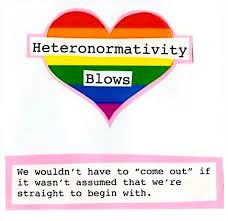
Have you ever wondered why homosexual people have to come out while heterosexual people do not? The word that explains this is heteronormativity, which is the set of cultural assumptions that heterosexuality is the norm in society. Heteronormativity is dominant in movies, TV shows, and many institutions, particularly schools in the United States.

Image result for heteronormativity

One of the main ways heteronormativity is reinforced in schools is through anti-gay curriculum laws, a broad category consisting of laws which restrict the discussion of homosexuality in schools, only teach abstinence, and do not teach adequate sex education for LGBTQ+ youth. The Columbia Law Review says 25 million children are exposed to these laws across the country.

Because of the lack of comprehensive sex education for LGBTQ+ youth, a report done by Planned Parenthood among other organizations writes that LGBTQ+ youth are more likely to engage in dangerous sexual behaviors that can put them at a much greater risk than heterosexual people their age.

Another way heteronormativity is perpetuated in schools is through the lack of LGBTQ+ history that is taught in classrooms. The U.S. News and World Report, there are currently only four states which require LGBT history to be taught in public schools. When LGBTQ+ students do not see themselves being represented in school, they are alienated and can often end up feeling much less validated with their identity and/or sexuality.

Not only are LGBTQ+ people at a disadvantage as children in public schools, but the inequality continues throughout college and adult life. The U.S. Department of Education found that in 2016, 75 colleges and universities requested to be able to discriminate based on either sexual orientation and/or gender identity. Meanwhile, many universities are making efforts to be inclusive and welcoming to LGBTQ+ people in particular from admissions to lesson content. This is so important because there is an extra level of stress added to the college process for LGBTQ+ students. Extra resources should be made available to these students, such a mental health resources, gender neutral bathrooms, and presence of LGBTQ+ clubs and groups on campuses.

As well as providing additional resources, it’s important for LGBTQ+ topics to be introduced to college students in regular classes in addition to specialized courses. Discrimination often stems from ignorance and exposure in college can play a huge role in combatting this issue.

In the United States, individual factors such as teachers, school curriculums, laws, and social norms, often combine to make LGBTQ+ people isolated from society as a whole. Through each seemingly minor discriminatory act to flat-out discrimination, the system of inequality is furthered and is then continued throughout an LGBTQ+ person’s life.

Flutes are for Girls, Tubas are for Boys

Gender is everywhere. it’s in the products we buy (do you prefer blue or pink packaging for your razors?), the tv shows that we watch, the places we go, and gender is engraved in almost every social institution, from religion to prison, you cannot escape gender bias. No matter how hard we try, it seems we cannot escape the binary that makes something masculine or feminine. Over the years, the question on gender theorists’ lips has been, “how do we deal with gender bias in the music classroom?”

The educational system is no exception. Everywhere you look in schools there is evidence of gender biases. This can be most easily observed in children’s behavior. In elementary school, a great example is the way children of a specific gender choose to play.

Educators are seen as guiding lights, especially in lower elementary schools. But this does not protect them from enforcing gender biases. As a music education major, I can’t help but think about the gender biases that are present in the music classroom. Art classrooms are often seen by students as a safe space for them to express themselves and escape the idea of the gender binary. As much that I (and I hope you) wish that were true, the gender roles that are present everywhere in the world still tend to seep through the acoustic panels on the walls and into the music classroom. I think the most prominent gender issue in the music classroom is what instruments are “for boys” and which ones are “for girls.”

Understanding how gender plays out in the music classroom can help music educators, band boys and choir girls alike, help their students see beyond gender biases and break down the barriers they create.

 Four main theories explain the way gender works in the classroom:

Along with these frameworks, it’s important to understand where gender appears in the music classroom, and how the music classroom has been gendered. There are two main aspects as to how music education is gendered: the feminization of the subject itself and the genderization of musical instruments.

Why do these biases exist? When first learning about instruments before choosing them, students may be shown teaching materials that only show pictures of boys playing tuba while also only showing pictures of girls playing the flute, which is evidence of the Hidden Curriculum. Warrior Narratives enforce masculine norms for young boys, which affects how they can act in everyday life. Finally, when students go against the instrument norm, their peers may see this as an opportunity to bully the girl playing the tuba or the boy playing flute, this results in borderwork. These frameworks are evidence that gender is a learned concept, however, they are so embedded in society that we don’t realize we are teaching our children to act this way.

The gender biases that exist in the classroom can largely affect a student’s experience in their music education. These biases, if not controlled, can create a toxic learning environment and prevent creative expression. The “gendering” of inanimate objects in the music classroom is a problem, and music educators need to guide students away from these stereotypes to host a more healthy and creative classroom.

Teachers can foster a gender-free classroom a few different ways:

  • using different language when first introducing and describing instruments to students
  • allowing students to try out different instruments

Using Children in Psychological Experiments: What’s the Cost?

Psychology is the study of human behavior and the brain, something that’s intangible. Studies and their results are key to being taken seriously in the science community. Experiments are key for these studies, and sometimes the questions are based around vulnerable participants. Children and adolescents are placed in morally reprehensible situations, all in the name of science. It is argued over whether the experiment and the results that came from it justifies those who were harmed in the process. It was not until recent history that we have taken notice, and claim, of the actions in the scientific community regarding experiments. Psychologists also have codes of conduct which they must follow in order to protect the participants involved in research as well as the credibility of the psychologist and psychology as a whole. 

It is hard to imagine people participating in a case study unknowingly in today’s society, but it wasn’t too long ago that horrific unethical ones were being conducted. One that stuck with me was the John/Joan case. In the 1960s, psychologist and sexologist John Money, who was employed at the John Hopkins Hospital, prompted the gender reassignment of Reimer. Reimer who was born a male, but endured irreparable harm to his penis in a botched circumcision as a child. It was only after the support from Money that persuaded Reimer’s parents to make the decision to raise him as a female. Reimer then underwent gender reassignment surgery and given female genitals. Reimer was actually the very first gender reassignment on a person who was born normally. His name was changed to Brenda, and as Reimer grew up, he received estrogen. Throughout his adolescence, Reimer was never told they he was biologically born a male. He even met with Money routinely and was unaware that he was the experimental subject in his experiment. This caused Reimer to suffer from severe depression and suicidal ideologies from a young age. He didn’t find out the truth until his father told him when he was fifteen years old. The trauma that Money caused a poor innocent child since birth is unfathomable. Reimer’s battle with mental illness ultimately lead to his death, he was only thirty-eight when he committed suicide. 

The John/Joan case is sadly only one of many psychological case studies involving unwilling and unknowing adolescents. Some psychologists are only fixated by the outcome and potential breakthrough in their theory and psychology. To attempt and manipulate someone else and potentially negatively impact the rest of their lives is a position no psychologist or researcher can ever take. Lives have been destroyed all due to data to back up theories. Children like David Reimer never get justice. It is necessary for the scientific community to have ethical rules and guidelines, and limit how far they’re willing to go.

Animals are a Human’s Best Friend

Have you ever heard the saying “dogs are a man’s best friend” or “Be the person your dog thinks you are.”? These quotes along with many more show how important animals can be to our lives. Animals have been used for everything from food to clothing but also for companionship and have now been linked to positive effects on humans and their health. Also, animals have been linked to a lower risk of heart disease, longer life expectancies and lower blood pressure. Lastly, service animals have become one of the most special jobs an animal can have. They have been used to treat people with both physical and mental disabilities.

For a more visual explanation of the pros of having a pet, watch this video!

One way animals help us in our lives is by affecting our physical health as well as mental heatlh. There have been many studies done to show how animals, specifically dogs, have been linked to decreased risk of heart disease, blood pressure and the increase in life expectancy. Increase in exercise also leads to a decrease in heart disease and lower blood pressure. According to an article by WebMD written by Lisa Fields, “dog owners walk more and have lower blood pressure than people who don’t have dogs.” showing that the increase of exercise and having a pet are related. One study that is infamous for supporting animals having an impact on human psychological health was a study done by Allen, K., Shykoff, B.E. and Izzo, J.L. In their study, they tested “a clinical trial in which hypertensive stockbrokers were randomly assigned to either pet or no-pet conditions. Six months later, when put in a stressful situation, subjects in the pet group showed lower increases in blood pressure than did those in the non-pet control condition.” These examples show the reader both mental and physical effects of an animal on their human.

The exact definition of a service animal as said by the Animal Welfare Institute, is any animal that is individually trained to do work or perform tasks for the benefit of an individual with a disability. Service animals are used to help people with their physical and emotional struggles. The training of service animals has been traced back to the early 1900’s. During World War I, German Shepherds and Labrador Retrievers began to be trained and used to help wounded vets. Today, the most common service animals are brace and mobility support dogs, autism assistance dogs, service seizure response dogs, hearing dogs and medical alert dogs [along with many others]. This goes to show the evolution of service animals and their many useful resources.

 In the end, animals are more important to our lives than we normally give them credit for. Besides being our top provider of food and clothing, animals serve as the great replacements and cure for some medications and diseases and the best companions and workers out there. Between helping people with health, both mental and physical, and helping us be better humans, it’s no wonder more people now than ever are moving towards owning animals in their own homes.

How Video Games Affect Mental Health

We continue to see video games dominating the recreational time of our youth. Recently released video games appear to be more addictive to its audience based on stories in the news about parents saying their children are glued to video games for endless hours. The main problem with video games being addictive is that it has a major effect on children’s social and psychological behaviors. For starters, there is a new term called “gaming disorder,” and it is meant for people who spend countless hours playing games. This term is not for players who have a lot of time played on games, it is more for the players that cannot control the urge to play for hours. If someone is at the point of being diagnosed with gaming disorder, this means that not only their social life is being affected, but also high priority events. There is a story about a man by the name Charlie Bracke, and he was horribly addicted to video games, to the point where they controlled everything in his life. For some people, similar to Charlie, video games are a stress reliever and a “safe place.” There are some scientists saying video games are not addicting but in fact is more of a coping mechanism to a bigger problem in people’s lives. Even though there are arguments saying video games are not addictive, it is seen as a phenomenon affecting a small percentage of gamers.

It is also important to understand that not everyone who spends a lot of time on video games has these sorts of problems. Some people are just very enthusiastic about gaming and few even make a living from it. There is a major difference between the two types of gamers. The addicted players can’t take their minds off the game and that affects their social lives. Whereas professional players get paid to play games and they still manage a social life because there isn’t a constant need to play. If children are becoming addicted, parents need to understand the signs and monitor their child’s relationships and school grades. Thankfully, there are some ways to help stop this gaming addiction problem from happening. The most important way to avoid addiction is to not sit on the couch playing games all day but to get some physical activity in your schedule.

On November 6, 2019, in the news, there is a new story about a young kid that died due to gaming. Piyawat Harikun is a 17-year-old boy from Northern Thailand and he struggled to do anything but game every day. At only the age of 17 Piyawat collapsed at his computer due to the fact he had many all-night gaming sessions that lasted several hours. In an article written by Ryan Fahey, it says, “He had broken up from classes toward the end of October – using the free time to play video games” (Fahey, 2). His parents would bring him food in his room and attempted to make him put the games down, but he never listened. This example just goes to show that even though the child told the parents they are going to stop playing so much, no action was actually taken. 

Image result for person sitting in front of computer