The hardships relating to sleep associated with narcolepsy patients

People with narcolepsy experience an increased amount of lucid dreams and nightmares, hallucinations, have higher dream recall and undergo cataplexy, a state of sudden paralysis of voluntary muscles, compared to healthy people. As people know, sleep is one of the most important aspects of life and getting good sleep is vital to succeeding in your waking lives.

People with narcolepsy experience many hardships related to sleep, causing them to live a more stressful life. Nathaniel Kletiman (1987) defined narcolepsy as, “One of the most suggestive spontaneous disruptions of the normal sleep-wakefulness rhythm” and is “characterized by repeated sudden brief attacks of sleep, occurring during the customary waking hours of the individual, usually but not always associated with attacks of muscular tonelessness known as cataplexy” (p. 233). 

In this research paper, two studies regarding dream characteristics of narcolepsy patients are explained and used to argue why narcoleptic patients experience many hardships related to sleeping and dreaming. In the study titled, Increased Lucid Dreaming Frequency in Narcolepsy Patients, it was highlighted how narcoleptics experience a higher frequency of nightmares compared to healthy patients. Due to this, they also experience lucid dreams more often. They experience fragmented sleep during the night time because of this, causing them to get a worse night’s sleep than healthy patients. They also often experience very vivid and dreamlike hallucinations during the night as well as during random sleep attacks during the day. Their day is often disrupted multiple times by sudden attacks of extreme sleepiness. More information can be found regarding these two studies at the following links, https://academic.oup.com/sleep/article/38/3/487/2416990?searchresult=1 and https://academic.oup.com/sleep/article/38/5/787/2416994?searchresult=1#125084850

Another hardship narcolepsy patients have to deal with daily is the possibility of experiencing cataplexy at any time. Cataplexy is, “a brief episode of bilateral weakness without altered consciousness that is usually brought on by excitement or emotion” (Aldrich, 1999, p. 155). This means they might experience drooping of the face and limbs, slurred speech and it can even make them fall to the ground. This is very serious and narcolepsy patients have to worry about it happening at all times. 

Cataplexy

It should be known how narcoleptics have many disruptions in their sleep and dreams which cause hardships in their daily lives. It is important for all people to be educated about this disorder and to understand why it is vital that research is continued so that one-day narcoleptics may not have to suffer from hallucinations, cataplexy, nightmares, lucid dreaming and much more anymore. 

p2: follow up

Ive decided a final topic for my P2. I am planning on researching and discussing disproportionate incarceration rates between the black and white community in relation to marijuana related charges. I am going to research further into the social, political and economic forces that drive black incarceration rates to be substantially higher than those of whites for the same or lesser charges.

P2 proposal

For my p2, I am planning on writing an essay concerning the topic of mass incarceration for the black community in this country. I plan on researching further into these rates and the reasons behind this mass incarceration epidemic in order to narrow down a strong thesis on one of the many driving forces behind these arrest rates.

Are The Movies More Than Just Entertainment?

Long story short: They Are! And they are influencing your political beliefs without you even realizing it.

There’s good news though. You can prevent this.

The movies are such a big part of modern American culture. They are seen by vast numbers of people all around the country. Directors, screenwriters, and producers can easily slip in any sort of message they want to in their films. A seemingly nonpolitical comedy film could have an underlying message hinting at a social or political issue. For example, when I was watching Why Him?, I didn’t think of it as having any political message. After all, it was a James Franco comedy. After watching it a second time, I started thinking that maybe the film was hinting at a social divide in the present world.

This led me to see where else political messages have been found in popular films. For example, the movie Avatar, which was the number one grossing movie of all time for a while, was not just a science fiction movie. It paralleled an issue in America that often gets overlooked. The plot of the movie is very similar to what happened when white people started colonizing North America and the implications it had on the natives.

That might not have been something you ever realized. Here’s how you can become more aware in the future. The most basic way to look for a political message is by breaking down the movie into what can be seen as the most basic summary of the movie’s plot. Using Avatar as an example, one could say the film is about humans going to a place that is not theirs to take resources from the natives and tension arises between the two groups. This basic summary somehow starts to sound more political or controversial than looking at the movie as a whole.

Why should you care? Politics are becoming an issue at the forefront of American society. The political divide today is arguably larger than ever. With another presidential election in the near future, it is imperative that all voters vote for who they believe is the right choice to lead the country. With outside influences from all over, including the movies, our political decisions can be swayed in one direction or another. By becoming aware of all of these political influences, it becomes clearer to make your own decisions, not the decisions that others want you to make.

P3 anxieties and plans

My P3 essay will be written on the overwhelming incarceration rates for the black community compared to the white community for marijuana related arrests and charges. My worries for this paper will be that I will accidentally contribute too much of my own opinion to the tone of the paper and use my sources to back it up, rather than use my sources as a baseline to build and argument with. I’ve also been struggling to find sources on this topic, as our country likes to pretend that this mass incarceration epidemic isn’t taking place. I hope to be able to build a really strong argument and include some special cases in which black men and women have been given longer sentences for non-violent minor drug possession charges than their white counter parts have received for violent charges.

Mindfulness Meditation: How This Process Helps Humans Survive the Detrimental Demands of Society

Image result for stress

Stress. Sometimes even that word makes people shiver. However, that does not have to be you. The usage of mindfulness meditation is a healthy process that relieves the detrimental stresses of a high intensity society on mental and physical well-being, and leads to numerous benefits. Mindfulness meditation should be implemented into a person’s everyday schedule because it may increase the overall quality of life by reducing everyday stress.

Meditation, in simple words, is sitting or lying down (you can stand if you really feel like it), and you take a few minutes to focus on your breathing and clear your mind. Some people also use yoga or other activities like that as their meditation. (https://www.ncbi.nlm.nih.gov/pmc/articles/PMC4895748/)

Going back to the terrible word “stress”, as a college student, you have probably experienced it before. Unfortunately, this stress is actually way more detrimental to your health than you think. If you are someone who wants to do well in classes, without burning out, or just someone who does not want to be stressed out from school, meditation is for you. Productivity and focus can be achieved through meditation. According to Ami Kapadia’s article (https://www.ncbi.nlm.nih.gov/pmc/articles/PMC5882186/), she is a primary care doctor who was completely burned out doing her job. This reduced the quality of her work. 

Yes… she is a doctor. You do not want a doctor to do their job terribly. She turned to meditation, and found herself being more productive, her burnout was reduced, and her quality of work increased. 

Image result for college students meditating
(You don’t have to look like this while doing it)

Now, obviously, most of you are probably not doctors, some may be planning to, or some may not be. Regardless, you are a student, and stress is a part of schoolwork. It does not have to be. Meditation is an easy (and free, for broke college students) to reduce their stress and increase the quality of their work. It gives you a break; it is like a mini nap where you’re not actually sleeping. Whether it is 5 minutes or 30 minutes, it is beneficial just to give yourself a break. After reading this, I challenge you to close your eyes, take deep breaths, and focus on your breathing and only your breathing. Notice how you feel a little calmer. That is basically because your heart rate has probably slowed down. 

Meditation is a way that you can thrive and achieve great things in school without burning out. Imagine having a 4.0 and no stress! What a dream!


Is the authoritative parenting method enough to apply to every culture?

My research paper incorporates how the authoritative approach is too vague to apply to every culture. This approach started from Diana Baumrind in the 1960s, and a lot of research has been done since then. 

From this, I dived into different cultures and looked for how they parent in different ways. I searched the ways parents in different cultures display their love, the reasoning for why some cultures say “I love you” and others do not, and the supervision of children.

The most interesting discovery was that in Japan, children as young as six years old walk to school and run errands without supervision. Parents in this culture want their children to be prepared to take on the real world so they follow this idea of “raising children to leave us”. They want their children to be very independent in the future, and also parents have full trust in the individuals in their community to look out for their children. 

 Compared to other cultures, especially the United States, supervision lasts all the way to a child’s teenage years. This is because the United States has less trust in the individuals in their culture than Japan, who has full trust in their individuals.

The other topics I explored had interesting surveys, opinions, and differences in each culture. The one study with 900 Chinese and Filipino high school students explained how their parents use a lot of instrumental support. All these topics helped show that each culture has different views on the best ways to parent. 

From all this information, I established two different directions that we can go to help alleviate this problem. The first, each culture finding all their similarities in parenting to include in the new authoritative approach definition. This will be a very detailed explanation of all the ways the cultures feel is a successful way to parent. Although, this will leave out a lot of additional information that could help each culture, like the don’ts and more successful ways to parent. 

The other direction is to simply drop the authoritative definition we have now and for each culture to establish their own definition. Then, each culture can add in all the dos and don’ts, so the parents in each culture have a good sense on how to parent. This direction is likely to be much more successful and will be able to include a lot more.

 If we tackle one of these ways, this will lead to more hope to having more self- reliant, successful individuals in the future. Do we really want more selfish, un-reliant people in this world? We all want the future generations to be happy and victorious, therefore this is where we need to start to make the individuals better in this world.

Is the Weather Why I’m Feeling Down?

Have you ever woken up on a cold rainy morning and dreaded the thought of getting out of bed to begin a day you already predicted to be lousy? Or on a different day, have you ever woken up to a blue sky and warm sun outside, urging you to jump out of bed and take on a new day? If your answer is yes, you’re not the only one.

I experience these behaviors every day and I have always wondered if this is a real psychological or scientific phenomenon, or if it is just in my imagination. Research proves several factors associated with weather have a strong impact on people’s mood, including time spent outside, temperature, season, hours of sunlight, and how we feel about the weather.  

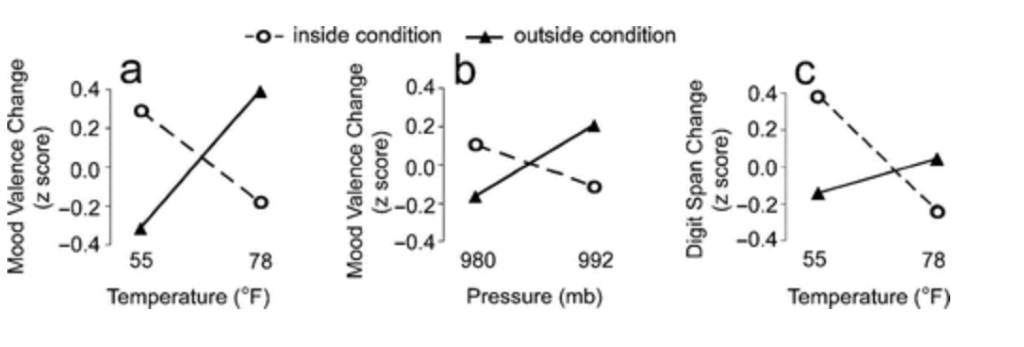
The Association for Psychological Science explored changes in mood from various levels of time spent outside to test the hypothesis that hours spent outside positively correlated with mood. They concluded that “Among participants who spent more than 30 min outside, higher temperature and pressure were associated with higher moods, but among those who spent 30 min or less outside, this relationship was reversed” (Keller et al., 2005) . The data is shown in Figure 1.  

Figure 1
Figure 2

These results were fascinating. Why is it that the amount of time spent outside flipped the results in the same exact weather conditions? When you spend less than 30 minutes outside on a pleasant day, people consciously resent being cooped up indoors. As seen in Figure 2, mood worsened for people indoors as the temperature became more pleasant outdoors, and mood improved outdoors as temperature increased. Another reasonable explanation could be that brief exposure to a beautiful day makes people feel irritated when carrying out normal activities indoors. Clearly, spending time outside is extremely beneficial and can be the solution to a variety of issues. 

Additionally, the temperature influences mental health. A study from the Journal of Psychosomatic Research found that people exhibited less sporadic behaviors when the temperature was consistent, and people’s behaviors fluctuated when the weather fluctuated. Moreover, the Association for Psychological Science showed season impacts mood, as warm days in the spring are best for mood and hot days in the summer are harmful to mood. In addition, the amount of sunlight is a significant determinant of daily mood. This may seem surprising, as many of us enjoy spending the entire day in bed. However, another study concluded that sunlight exposure is positively related to job satisfaction and lowers depressed mood. 

After researching the effect of weather on mood and mental health, I learned how influential the weather is on everyday life. No matter how sensitive you are to weather effect, it impacts everyone to some extent. In order to overcome the struggles that it causes, we must be aware of how strongly it can affect us and that is why this information is important for everyone to be informed of. 

I’m Already High Anxiety

What worries me the most about this paper is the word count. I will either exceed the count completely or I will not be able to find nearly enough research on my topic to meet the word count. Of course, this raises the concern for available research. My paper is more scientific (I’ll be following the APA format by the way), so I rely heavily on previous research. Unfortunately Art Therapy and Schizophrenia do not have many research papers, so it is my job to try and persuade others on why research of Art Therapy’s impact on Schizophrenia is so important (bkwjejh).

So to sum everything up, future me is going to be like: “AAAAAAAA,” but as of right now I’m just chilling.

p3 struggles

For my paper I have some concerns. I am worried that it will be hard to answer my thesis or think of the question to answer. I am also worried about how I am going to make the word requirement, I know it can be a little bit less, but I feel like I will not be able to get the minimum. Im going to try to find some good sources so i can write a lot about it.