Transhumanism is a wonderful thing because you get to advance your way of life. Transhumanist think that it is potential but also a danger of emerging technologies. Its like an chameleon how they can take the color of anything, this can transform themselves into different beings. Think about all the people that hate their bodies with just some science you could look like beyonce and have a brand new identity. Everything that you thought was something could be something different. Transhumanism can really change the world in the future if the scientists invest more into it.
Space Colonization Dooms Earth
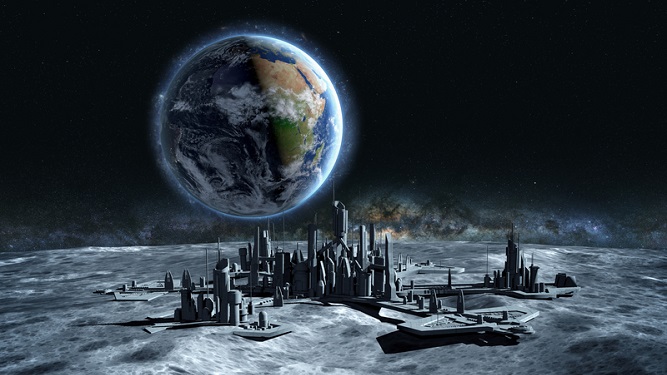
Sure, the colonization of the moon or Mars sounds fun, but what does this mean for Earth? When the colonization of some other planet occurs there will be great hope that the human race will progress. Eventually, people are going to want to move to this new planet to escape what seems like a doomed Earth. With a bright future ahead in space, Earth will eventually become run down and uninhabitable. Space colonization only leads to Earth’s demise and chaos.
Have you ever seen the film Wall-E? If you haven’t, the general idea is that humans eventually move to space because Earth becomes one giant dump. This will happen to our Earth if space colonization ever occurs. Currently, there are many campaigns to try and save the planet. This is because we don’t have another planet. When we can eventually move to some other planet, there will be no need for these sorts of campaigns. Why would we need to save the planet if we can just move on to another when this one goes to trash? Eventually, the fictional film Wall-E will become the animated documentary of Earth (minus the fact that there would still be plants on Earth).
This video will show you exactly what would happen if humans suddenly packed up and left Earth. (It is actually very interesting)
Before we know it, there will be no need for some government organizations. We will have no need for the Environmental Protection Agency. Their job is to make sure the planet will be here for years to come. The thing about space colonization is that we won’t need this planet for years to come. By the time Earth is gone, we’ll already be moved on to Mars or some other planet. Once we know that we can just transfer over to another planet, we will just end up destroying planets at an unprecedented rate. We will have no need to look after these new planets either if we know that something new can be obtained easily.
Before we know it, the day will come when we board the ship and head off on our one way trip to Mars. We’ll hop off the ship onto martian soil and then what? Countries will no longer exist on this new planet. Establishing a government will be virtually impossible. Chaos would erupt. There would be no law. Outer space would quickly become the new wild west.
After carefully examining the impact that space colonization would have on our glorious Earth, it is safe to say that full space colonization would in fact lead to Earth’s demise.
Transhumanism: Impractical and Unethical
Transhumanism is a complex topic that is extremely controversial and debated over, but I will focus on the reasons it should not become a reality in society and why it is unethical. Transhumanism is the belief in advancing the human race to evolve past a natural level of development using science and technology. Transhumanism is unrealistic and immoral because it is impractical, there are chain reactions among humans, and it results in a loss of human identity.
Transhumanism is impractical because it stresses the issue and unpredictability of attempts to guide living human products of biological evolution. Biologist Stuart Newman recognized how cloning and genetic engineering are disruptive of embryonic development so it would make sense for this to be the same case. If those human engineering examples, along with several others, were disruptive and unsuccessful, why would this be any different? Therefore, it should be unacceptable to carry out this technology because there are countless risks involved and it would be extremely dangerous to humanity.
Another reason I do not support transhumanism is because there would be several chain effects regarding people’s reactions. For instance, if human bodies are engineered for technological purposes, people are going to want to use that technology to physically alter themselves for selfish means. People will use engineering to look skinnier, change their facial features, look younger, and so many other ways. Once we open the door to transhumanism technology, there are so many other things people will want to take advantage of with the technology.
Finally, transhumanism is unethical because it results in a huge loss of human identity. Ethicist Bill McKibben claimed it is morally wrong for humans to tamper with and play around with fundamental features of themselves to overcome obstacles. For example, it takes away the meaningfulness of life. If we’re able to manipulate our bodies to overcome any limitation, then carrying out a life would no longer seem meaningful. If this becomes a world where any constraint on physical or cognitive ability could be technologically solved, the idea of existence itself would have no substance. As humans, we learn to appreciate our life most when we are faced with a life-threatening obstacle or health issue, but that gratefulness and meaning behind our survival would disappear if the human threshold was limitless with transhumanism technology.
To Meme or not to Meme
To Meme or Not to Meme is an article written by Maya Walker, a young woman who struggles with depression and suicidal thoughts. Walker expresses her struggle with depression in relation to the internet phenomena of memes. Memes, in recent years, have become one of the most popular forms of comedy shared throughout the internet on multiple social media platforms such as Instagram, Twitter and Facebook. While memes concern a wide range of topics, Walker touches specifically on memes that joke about suicide and depression. Walker begins her essay by diving into the darkest time of her life. She explains how she fought daily suicidal thoughts, her only support system being a local parking lot that she would spend hours, parked in her car and crying in. When Walker made efforts to reach out to her friends to seek support for her depression, her friends gave her battle very little recognition, for the simple reason that depression and suicidal tendencies had come to be normalized by internet memes. Walker explains how the internet is flooded with depression memes, all of which paint the brutal mental illness in a comedic light, making it seem as though everyone wakes up everyday wanting to kill themselves. “This is indicative of our society’s tendency to use humor as a coping mechanism, but the widespread nature of the internet and the many platforms within it means that people that do not consider the potential emotional and psychological effects their words may have on an unknown audience.” Walker writes, establishing the notion that these memes are used as a form of comedic relief as well as a bonding method amongst those who struggle with these illnesses and those who don’t understand the repercussions of stigmatizing mental illness.
Walker’s argument for the implementation of better mental health support across social media resonated deeply with me. Her use of pathos and ethos provided me with an understanding of both the subject matter at hand and the urgency Walker is broadcasting in her essay. My one issue with the flow of the essay is that Walker is slightly repetitive with her arguments. Although she builds her argument confidently in a manner that strengthens the message she is trying to relay, Walker restates the same points in the essay multiple times which causes it to feel a little drawn own towards the end.
If everyone is the same, what is the point?
Transhumaism has many components to it, but the one I am going to focus in on is how this will take away from the fact that we are all special and different in our own ways. If transhumanism is a success, then it will turn into all people thinking and acting the same way, which goes against the idea of self actualization in each individual.
Everyone is born differently, some struggle more than others and some things come easier to others. We are born a special person and each individual has to use their different strengths to achieve that idea of being the best person that they can be. If transhumanism is added, everyone is going to think intelligently and act in similar manners. This whole concept takes away from individuals being special in their own ways because it is going to bring us all together to basically make the same person in each individual.
Think about how boring it would be to live in a world where everyone acts and thinks the same. How will we compete with one another? How will we act differently to certain situations? How are we supposed to feel human emotions if our thinking is being controlled? This is the downside to transhumanism where we lose all human features that make us special and who we truly are.

Transhumanism truly does everything for you, it makes its own decisions and thinks on its own. It is truly just a body with artificial intelligence doing everything for an individual. Where truly the question needs to be raised, what is the point? A human is completely lost inside the body now because there is no more thinking and reacting going on in our minds, and we lose the emotions we typically feel, which is one of the most important aspects of a human being.
People admire having different thoughts and feelings towards certain events than other people do, it is what separates people and allows them to be unique in their own ways. Transhumanism will erase all the special components in an individual, and will make everyone the same. No more conflicting points, no more making young teenage stupid mistakes, no more emotions regulating our behavior. All components of human life will officially be lost if artificial intelligence takes over the world.

Transhumanism May Cause Increased Tension in Society; or Between You and Your Neighbor
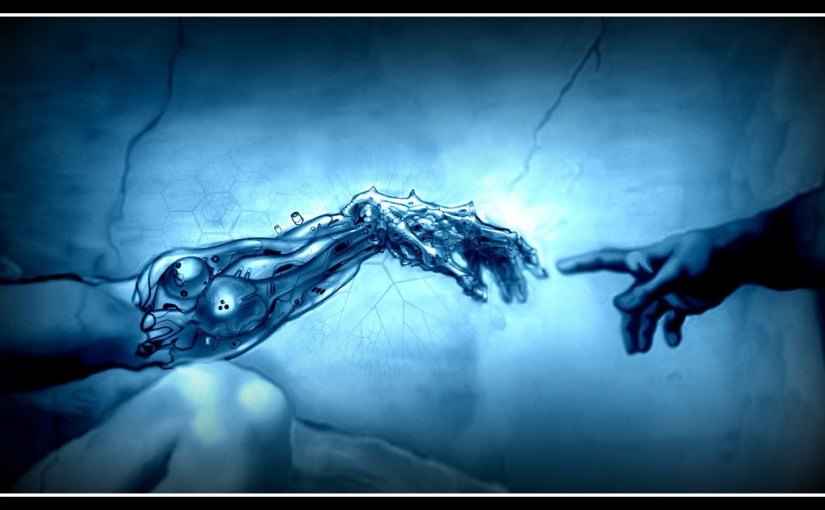
Transhumanism is unethical and should not be something brought into everyday life because it may give unfair advantages to humans and cause competition within society. Per the Wikipedia article, transhumanism is a movement that supports advantages to human condition, physically or mentally. These advantages can stop disabilities, promote immortality, and many other things. I am focused mainly on the physical advantages of transhumanism, because I have grown up as an active and athletic person, and just the word “physical advantages” makes me cringe. I will explain this through example that may make you look at the way your neighbors do things.
For example, if you receive a procedure to your body that increases the speed at which you can physically mow your lawn, your neighbor may observe that also try to find new ways to mow their lawn faster. If people are advancing the way they do normal things every single day, it is going to create a competition amongst people in society who want to keep doing things better and better. Your neighbor will keep trying to top you, and you will keep trying to top them, and mowing lawns that often is simply not good for your grass.
For another example, if I am working hard every day outside playing basketball, and I see my younger neighbor receiving transhumanistic advantages to make them make a basket every single time they shoot, that would feel unfair. They did not have to go through all of the actual hard work to get to where I am, and yet they have a higher skill set than me. They did not have to experience hardships to get to that point. Because of this physical advantage the transhumanist movement has caused, I will now experience hatred for my annoying neighbor.
Tension between neighbors would just be the start if transhumanism became prevalent. It would branch later into greater communities, sports/athletics, politics, and even global problems, and everyone would simply make a competition out of everything.
To Meme or Not to Meme
Maya begins her essay by talking about her personal struggle with depression and suicidal thoughts. She claims that internet memes about depression/suicide was a key factor in her mental health issues, which is essentially the crux of her argument. She goes on to explain that memes are largely a part of millennial and generation z culture, and today’s most relatable meme trend is mental illness. Mental health itself has lost its stigma in recent years, making people on the internet much more willing to share their struggles. Maya is arguing that the dark humor memes that have become popular across social media platforms normalize unhealthy behavior, putting internet users at risk of copying those unhealthy behaviors. She concludes that the manifestation of these memes in real life can have potentially deadly effects on the youth of America.
What makes Maya’s argument most compelling in my opinion is the relevance, or kairos, of it. We are living in a society dominated by social media, and memes have become a cultural norm amongst the younger generation. It’s significant, it’s timely, and it attracts human interest. Speaking for myself, I’ll say that Maya’s article is the one that immediately jumped out at me compared to all the others.
I’d say that Maya successfully presented her argument. Her topic was relevant, she was clearly informed, and knew which tactics to use in order to sway her audience.
Death, Drugs & Rock ‘N’ Roll
Lauryn Daniels explores the use of drugs at festivals and how authorities are handling their increased use in her persuasive essay. Daniels recently went to a music festival herself and witnessed an astonishing amount of drug use, which implored her to further study the subject. Throughout her essay, she details how different drugs affect their users and the consequences that accompany their use. She also includes how authority figures are handling the influx of festival drugs – and how they should be trying to help users take drugs safer instead of banning them altogether and slamming down on people who break these rules.
The author mainly uses logos when she conveys facts and accredited examples about drug use at festivals. She lists facts about what drugs do, what drugs are being used, how they get them in, and risk factors. All these facts help the reader gain knowledge about the subject so they can form a stronger opinion.
The author uses ethos when she uses credible sources in her essay along with pathos when she uses specific examples of people affected by drug use. Kairos is also used when Daniels tells of the rising death count and increase in drug use that is on the rise, and therefore is an urgent topic.
Overall, Daniels does a good job of convincing a reader that authorities should be trying to contain and minimize drug use at festivals civilly through harm reduction programs and education rather than force and heavy policing. She supports her argument with facts and reason while also mixing in credibility and emotion.
Putting a Price on Life.
Alex Arellano is about to go into medical school but may have to think twice about it because of the cost and the amount of student loans he has and will have. He was in the hospital a lot as a kid because of the Swine Flu and water parasites, as he lived outside the country at the time. While coming to America later on, he found his dream, becoming a doctor. The cost made him wonder if saving lives are worth it. There is a shortage of doctors and part of the reason that is true is the student loans.
Arellano does a good job including pathos because he makes the readers feel bad for him. He talks about him being in the hospital in the beginning paragraph, which for me made me want to keep reading. An example of pathos is, “I have lived all around the world in my lifetime, but the one place I called home for most of my childhood was the hospital. From catching the Swine Flu in Singapore, to getting water parasites in Vietnam, none of my constant visits to the ER could prepare me for the bug that would afflict me for the rest of my life: the dream of being a doctor (1st paragraph).” This does a great job of making the audience feel bad for him. It was a good idea to put it in the beginning because it opens the eyes of the audience to feel bad for him.
The thing that he needs to fix is to use less of Logos. I get that logos is a very strong way of persuading people because it shows facts, but for him it is too much logos. It is too much because in every paragraph besides the intro and closing paragraph it is in all of them. That can be a turnoff for some readers, I know it is one for me. But some people also think it is stronger to show a lot of logos.
Superbugs & Technique
In the essay Antibiotics & Superbugs: The Future of Health?” John Bachman-Paternoster explains the tragic event he and his family went through with his father in March of 2017 . His father went into the hospital with an illness involving his pancreas that could have been cured. Instead, he was never able to leave the hospital, and unfortunately, died because he was infected by what Bachman calls a “superbug.” This type of bacteria is extremely aggressive and evolves very quickly. Once you are infected, there is not much you can do, and doctors and scientists are still figuring out the superbug and all its elements. Because of this tragic event, Bachman wants to bring attention to scientists and doctors about the superbug and how it needs to be eliminated. Bachman thoroughly explains the theory of how superbugs come about and how they are able to continue to live. His use of ethos, pathos, logos, and kairos helped to form a well-rounded essay that allows the audience to become more engaged in. He asks the readers’ questions to draw their attention and to have them further their understanding of the superbug epidemic. His choice of words and factual evidence allows the reader to trust his research as a writer. He elaborates on each piece of evidence leaving the reader with all the answers they would need to understand more about the superbug. Bachman’s intentions were to draw attention to the audience as well as more doctors and scientists to stop this illness of evolving even more. He wants the superbug to no longer be an issue in hospitals and other areas. This essay was very well-written and his intentions were very clear.
 E110 FA19 Class Blog
You must be logged in to post a comment.