Images have been dictating emotions ever since the age of the electronic culture. The introduction to images, creating a uniformal societal experience, has allowed individuals to introduce features through the human eye in order to evaluate an images emotional content. With meaning comes representation, and the emotional qualities an image contains holds a silent power.
The world created by pixelation is seemingly serene. The sky is as clear as ever, perpetuating a calming blue color. The majority of the photo is engulfed by clear, vibrant waters. In the distance a coastline is revealed, allowing the assumption of a society close enough to feel safe, yet far away enough to leave your troubles behind. The center of the image contains a single person on a yellow kayak. Behind the person on the kayak is what appears to be a shark, floating in the direction of the boat. My first reaction to the image was an overwhelming feeling of anxiety. The shark, so easily lurking behind the kayak invoked fear. I saw what most people would, an inevitable attack on the human carelessly engaging with the monster’s natural habitat. After my anxious episode, something changed. The picture I originally unfolded had another story waiting to be told. I saw the shark peacefully swimming by, the man acknowledging the shark, and smiling.
In society, images are usually literally painting a picture. To analyze them with a conscious approach you must ask yourself, “what is it trying to tell you?”. Being aware of the power a simple logo may hold over you is enlightening. In the modern world we live in, a picture is worth a thousand words.
Many people all around us are extremely invested in a certain religion. Not all people, but many would be surprised of how important it is to many, and how it strives people to live.
In my situation, I have grown up with extremely religious family members, including cousins my own age and younger. With how they portray their beliefs, morals, rules, and customs, it has put a very large dent in how I view religion today. I have felt for quite awhile, that religion should never come in between someone and who they truly are or, who they want to be based on someone else’s religious views. I was raised Christian, although neither of my parents are religious at all. I never thought anything negative about Christianity, or even religion at all, until about freshman or sophomore year of high school.
I have been exposed to the way my cousins view homosexuality very often, almost each time I am around them. They all believe that homosexuals are ‘faking it’ or doing it for attention. I have often tried to explain that this is not the case, and they would not understand any of it because they are just simply not homosexual and I tell them that homosexuals are born that way. Each time, they look at me as if I have three heads. I have backed off completely when the topic becomes. There is no point in trying to change the way they think, because they only believe that what the bible says is true. Because of the lack of understanding of homosexuals and the closed-minded views of the topic, religion should never be able to have opinions on anyone or anything except themselves, and their own life.
Religion does not only affect homosexuals, but it also often invades an education, personal choices such as abortion, and can often be brainwashing. The bible cannot be the only thing that decides morals and what is teaching people right and wrong. Based on my research, many societal issues are not even brought up in the bible, which is contradicting to what christians otherwise say.
Very invested, religious people, often have a lot to say on certain topics in society today, although, they know close to nothing about it. Everyone should have the ability to make their own choices for their own life, have the ability to be who they truly are and live freely, because, they are the only one who truly knows what they want. Nobody should be able to say otherwise, especially those involved in a religion that others may not believe.
Featured in the advertisement is notable celebrity, Taylor Swift. She is wearing a red dress and is pouring a glass of Diet Coke while looking into the camera. She is sitting behind a table that is set for multiple people. There is already a filled glass of Diet Coke on the table while she is pouring the second glass. In addition, there is a sweepstakes included in the advertisement. The sweepstakes includes the chance to win a gift card and cool Diet Coke and Taylor Swift products. The main colors included in the advertisement are red, white, and black.
The advertisement’s message is that if you, as a consumer, are to drink Diet Coke, you could be as extraordinary as Taylor Swift. Since she is a notable celebrity, the company uses Swift in order to entice her fans to drink their product. The message also includes the chance of winning a gift card and other cool prizes. Taylor Swift is a world-renowned artist, so if she drinks Diet Coke, it must be good enough for the common person to drink it too. After looking for a few more seconds, it is clear that the meaning of this ad is to get people to “share a Coke” with Taylor. There is already a full glass on the table, but Swift is pouring another one, which the viewer can assume is for them. In order for them to get that glass of Diet Coke, they have to buy the product.
The product’s advertisement is arguing that their product is good enough for celebrities, so it is great for you too. Diet Coke is also arguing that their consumers will be extraordinary if they buy their product. The money and prizes allow the company to pull more customers towards them and away from competitors. Furthermore, just a year before this advertisement got published in 2014, Taylor Swift had released her song “22.” This song conveys the message about being young and feeling extraordinary, which is why Diet Coke then argues in this advertisement to “Stay Extraordinary,” but the consumer can only do that if they buy the product.
There are several rhetorical strategies that are prominent in the advertisement for Diet Coke. For instance, the appeal to logos is seen in the lifestyle of Taylor Swift. Soda has been infamous for problems such as obesity, but then we see this contradictory image of a young, skinny, seemly healthy celebrity urging us to buy soda. The positive behavior can be identified on how drinking Diet Coke seems good for the consumer since Taylor Swift is a thriving celebrity and also drinks the product. There are appeals to ethos in having Taylor Swift be the face of the advertisement, since she is well-known, and by having the logo of Diet Coke included in the advertisement. The colors play into the appeal to pathos because the red all around the scene plays into our emotions. The red is a symbolic color as it is found in the Diet Coke label and is also a symbol for love and passion.
The woman in the bed just wants to be left alone from the world. She wanted to just hide in her bed and not come out at all. she can also cause anger, fear, sadness and feelings of helplessness if the person does not know or understand what is happening. The persistent feeling of sadness or loss of interest that characterizes major depression can lead to a range of behavioral and physical symptoms. Depression is a serious medical illness. It’s more than just a feeling of being sad for a few days. The author is showing you how it feels to feel upset not being able to talk to no one but instead wanting to run.
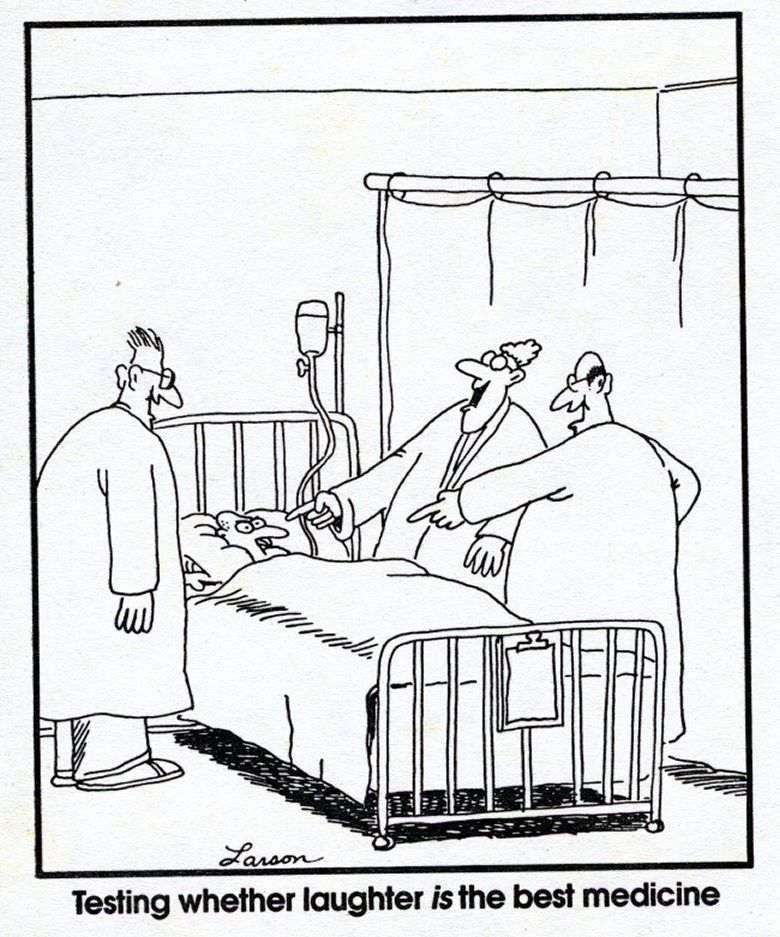
In the medicinal world, top researchers are always trying to find new ways to cure diseases. Whether it’s more cost-effective or time-sensitive, there is always research being done to improve or create medicine all over the world. Yet, what if there was a way to cure both physical and mental conditions that didn’t require any money and everyone could get access too? Well, there already is; laughter. The age-old saying “laughter is the best medicine” is, in fact, true to its word.
To identify if laughter truly is the best medicine, we must get an idea of what happens to our bodies when we laugh. Luckily, Rod Martin goes over this extensively in his journal article Is Laughter the Best Medicine? Humor, Laughter, and Physical Health. His first example reveals that “laughter might produce physiological changes in various systems of the body, which may have beneficial effects on health.” This includes how it “relaxes muscles, improves respiration, stimulates circulation, increases the production of pain-killing endorphins, decreases the production of stress-related hormones, and enhances immunity.” If these are just some of the physiological changes, one can only imagine how many other influences it has without us knowing.
Humor can be used to diffuse a situation and turn it from negative to positive. When the embarrassing action or traumatizing event becomes the focal point of a joke, it creates a better sense of understanding and moving on from these experiences. Todd McGowan reiterates this in Only a Joke Can Save Us, explaining “In order to experience comedy even in trauma, we must experience the trauma from a distance and simultaneously identify ourselves with the traumatized subject.” If we don’t look at things through a positive lens, it can have a long-term effect on our mental health. With this mental block of negativity holding us back, it prevents us from really getting the most out of life. For students especially, negativity would limit them from doing their best in school and maybe even having a social life. Yet, humor helps in that sense too. We fuel each other’s humor by making one another laugh. Rod Martin explains that “humor may indirectly benefit health by increasing one’s level of social support. Individuals with a good sense of humor may be more socially competent and better able to reduce tensions and conflicts in relationships” A positive outlook accompanied by a good sense of humor can allow us to flourish in society. We are already very social animals so adding laughter to the equation will only increase our compatibility and decrease our negativism.
Laughter can even reach lengths that are very unexpected. Take Bryanne Patail as a prime example of this. As a medical technology professional, he actively “deals with patient deaths and injuries caused by medical error or device malfunction.” Yet, he still finds a way to incorporate humor into his seemingly mundane job. This emphasis on humor in the workplace is able to set a great standard for positive mental health. Bob Stiefel, the director of a clinical engineering department, agrees “adding that humor can also be used to reinvigorate people trying to resolve a knotty issue.” With too much seriousness among companies, it can cause these workers to lose interest in their job and potentially not perform as well. There needs to be a sense of lightheartedness among coworkers to establish better connections and this can easily be done through inside jokes or funny moments. Stiefel also puts out there that “You definitely don’t want to be joking around in front of patients and visitors. They need to know you take your work seriously.” Although this puts some restraints on the lengths that humor is able to go, it is for the best because if there is excessive joking around, then nothing would get done. Like medicine, you don’t want to be laughing too much. But using it to get some work done in the workplace is generally a morale booster. Humor in appropriate doses allows us to turn mundane experiences into uplifting and less forgettable ones. This, in turn, can keep us focused on tasks at hand by joking about them or even giving us a quick break after working on it too much. This is why humor in our workplaces is crucial and has more impact than most people generally think.
With the various examples listed above, it can be proven now that the saying “laughter is the best medicine” can truthfully be applied within our society. No longer is it just a saying that conveys that we should stay positive during times where we need medicine. Now, not only is there plenty of proof researched on this topic, but those who might have doubted this information or not known it can put it into use. Whenever someone is physically or mentally ill, someone who knows this information is now more likely to use laughter to aid them in the recovery process. People can even use the information found throughout this paper to use in their day to day lives. When unwanted stress forms or when something small but negative happens, if people remember to either make a joke out of their situation or find something to laugh at, they’re more likely to overcome that negativity, leaving us healthier and happier in the process.
Schizophrenia: the complete fragmentation of the thought process. Schizophrenia is a chronic and severe disorder that heavily impacts the prefrontal cortex, a part of the brain critical for cognitive thinking and decision making (Karlsgodt & Cannon, 2010). With various types of Schizophrenia, it is difficult to keep track of its different symptoms; however, most patients exhibit what doctors now call positive, negative and cognitive symptoms. Positive symptoms include hallucinations and delusions which are considered “outward expressions” (Positive & Negative Symptoms of Schizophrenia, 2019). In other words, positive symptoms mean a patient has lost touch with reality. Negative symptoms describe an “[internally] distorted emotional state” (Positive & Negative Symptoms of Schizophrenia, 2019). This includes hyperactivity, confusion and disorientation, and agitation. Lastly, there are the cognitive symptoms. These symptoms include lack of attention, poor motor skills, deficits in learning, abstract thinking, and memory (Foster, 2018). The use of medication has proven fairly successful when treating schizophrenia, but what other methods can be used to treat Schizophrenia? I turned to the idea of art as a possible treatment.
The use of art therapy in the treatment of psychological issues similar to Schizophrenia, such as Attention Deficit Hyperactivity Disorder (ADHD), Post-Traumatic Stress Disorder (PTSD), and general Anxiety or Psychotic Disorders, is effective. Like Schizophrenia, ADHD attacks the frontal cortex of the brain, which means decision making, memory, social behavior, and cognitive functions are all impacted (Aacap, 2017). While medications for maintaining the symptoms of ADHD are available and reliable, preventing the condition (almost) entirely is far more desirable. In one study, Hina Ayaz from the University of Karachi focuses on the use of art therapy in the intervention of ADHD among children predisposed to the disorder. Her assessment concludes that art therapy can be used successfully in the intervention of ADHD (Ayaz, 2018). These positive findings are particularly important when considering the possibility of art therapy’s effectiveness on Schizophrenia. If this type of therapy is able to help address the symptoms of ADHD and intervene during its earliest stages, then there is also a possibility of it doing the same for Schizophrenia. But with hardly any research available, we will not be able to firmly reach this conclusion.
Of course, preventing most mental disorders during their onset is not entirely successful and depends on an individual’s specific circumstances. While the predisposing genetic factors increase the risk of developing Schizophrenia, it is the environment (childhood upbringing, psychosocial factors) that causes the onset of this debilitating disorder. Therefore, looking at the effects of art therapy on trauma related psychological disorders such as PTSD is critical. According to the American Art Therapy Association “art therapy is used to reduce debilitating symptoms” like mood or anxiety disorders, disorders that are also experienced by Schizophrenics (The Traumatic Impact and Aftereffects of Gun-Related Violence, 2019). If the use of art therapy is able to relieve the symptoms experienced and traumatic memories relived by those who suffer Post-Traumatic Stress Disorder, then providing Schizophrenic patients with art therapy during a psychotic episode or a general therapy session may prove extremely successful.
When looking at basic treatment options for any psychological disability, options include medication and various forms of therapy. This means, pairing art therapy with current medications issued for Schizophrenia is more effective than using either method alone. Now, there are two categories of medication based on symptoms that are offered to treat Schizophrenia. One category is the first-generation antipsychotics (typical). These include medications like Thorazine and Prolixin and while they treat symptoms of Schizophrenia, they can also cause problems with motor functions (NAMI, 2018). These are terrible side effects that no one should have to endure. But what if there was a way to reduce the chances of these symptoms or prevent them? That is where art therapy can come in. Art therapy allows a patient to practice precise motor skills by painting, drawing, and coloring. Not only is this extremely therapeutic and beneficial, but it is also fun and utilizes the prefrontal/frontal cortex. The other category is second generation antipsychotics (atypical). These types of antipsychotics include Clozaril and Invega, which side effects include weight gain, diabetes, and other physically challenging impairments (Uçok & Gaebel, 2008). While art therapy cannot directly help patients with the physical side effects, it can help with any mood disorders caused by the physical side effects. Art therapy allows patients to express or project themselves in creative ways (Author, 2019). If a patient is not able to communicate their thoughts through words, art can be utilized as a creative outlet and ultimately gives them a voice as well as a source of therapeutic comfort.
Unfortunately, without the proper scientific research to back this subject, it is difficult to fully understand the effectiveness of art therapy on Schizophrenia. What makes this matter even more disappointing is the thought that art therapy may be able to catch and address the early symptoms of Schizophrenia. Catching Schizophrenia before it becomes chronic is crucial, because the patient will be able to make a full recovery as long as they remain in the correct environment. Of course, this lack of research can change by promoting the theory of art therapy as a method of treatment for Schizophrenia. Platforms such as the American Art Therapy Association are wonderful for getting involved, learning about, and spreading information about this type of therapy to the public. Research on this topic must be considered because not knowing the full effects of art therapy on this debilitating disorder may be causing unneeded suffering. By furthering the research into this topic, rehabilitation rates for this terrible psychological disorder increase and Schizophrenic patients suffer less. If there is a chance that art therapy has a large impact on Schizophrenia it is crucial that we further research on this topic. It may also open doors to new ideas and innovation regarding psychological disorders such as Alzheimer’s.
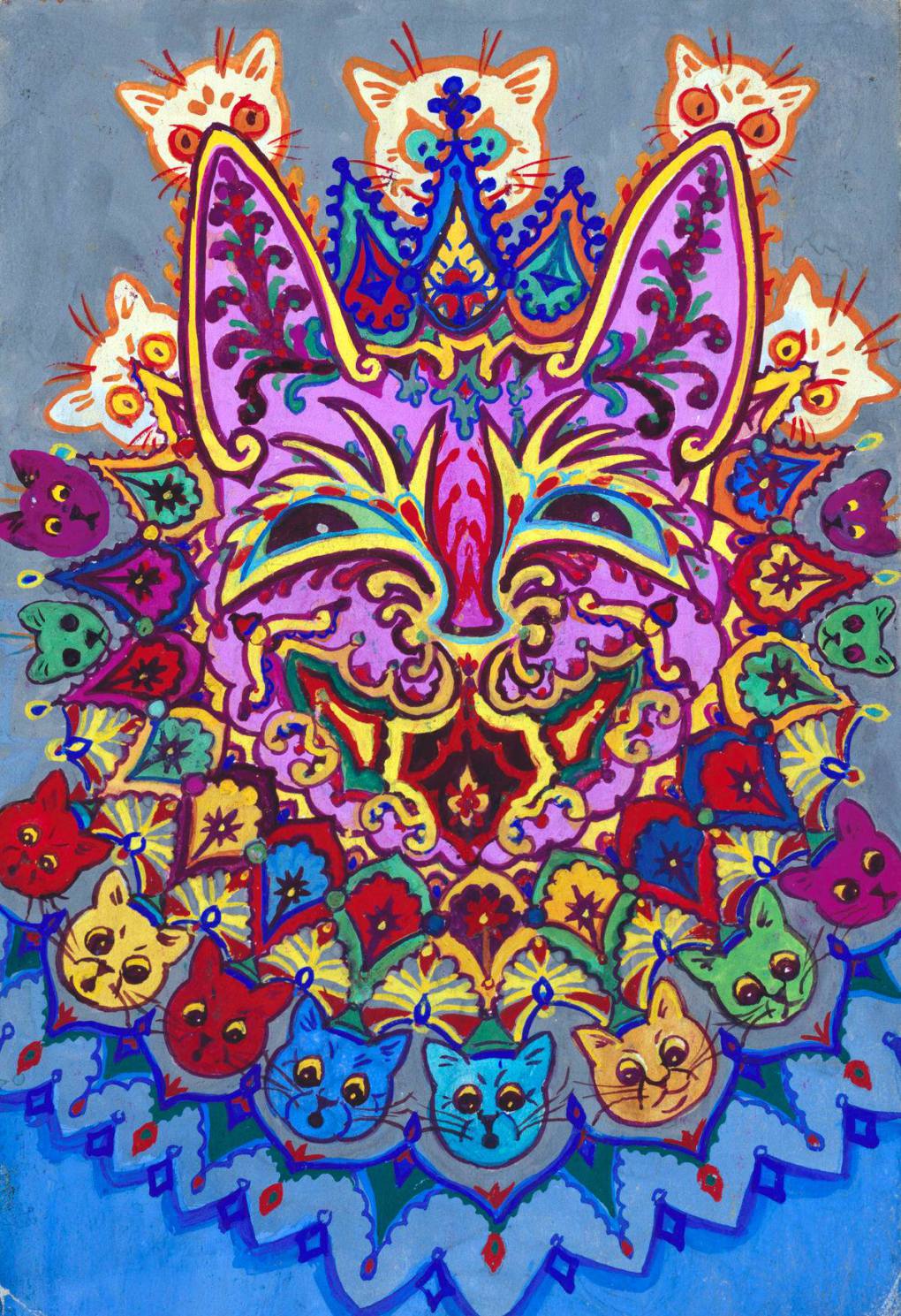
Fun painting of one of Louis Wain’s cats. He is a famous artist known for his psychedelic cat pictures. He also suffered from Schizophrenia and well… Art!
The New York Times posted an image titled, Social Media, and it reveals the sad truth about people portraying themselves falsely on social media. The overall meaning of this image is that social media makes individuals seem happier, and show them living a more fun and adventurous life; but this does not represent reality at all. In simpler terms, social media depicts individuals incorrectly.
As stated before, this image was found in the New York Times, which shows that the target audience is adults primarily ranging from their 30s- 50s. It is important to reach this audience to reveal the ugly truth about people pretending to be someone they aren’t on social media. The reason is to bring awareness to the viewers to not believe everything they see on social media.
Many different concepts are used in order to reveal this message of social media allowing an individual to be someone they aren’t. The usage of color in this image truly reveals how social media represents this “happier” and “livelier” life. The colors used are all bright, including a lot of pink, and some green and yellow. These colors make the viewer feel happy, peaceful, and relaxed, which all explain the life shown on this social media account. Whereas, the rest of the colors used are very dull, strictly black and white. The colorless part of this image reveals the man’s real life to be plain and boring, since it displays no real color in his life.
Another aspect seen in this image is the usage of lines. When looking at the black and white part of this image, the lines are seen to leave some gaps and don’t completely connect with the other lines. This may represent the “gaps” in the man’s life, which may include the lack of adventure and happiness in his life. Another idea is social media may fulfill his life. This is seen because once you reach the colorful part of this image, all the lines are connected.
Lastly, the major symbol being used in this image is the cell phone. The cell phone allows this man to portray himself as a different person. It also leads the viewer to the theme of this image, which is escaping reality. Once this man picks up his phone and looks at it, he instantly escapes reality and becomes someone else.
Overall, this image has a message that is very true and deep. This image is mainly used to bring awareness that many people may reveal themselves differently on social media. Even though this image is not as complex as others may be, it still reveals a very truthful message. In the end, there is much more to a person than what is displayed on social media.
This image is an advertisement for a sale at Urban Outfitters that was received via email. The ad is trying to tell us that there is a 30% off sale on appealing clothing, such as sweaters, for the current weather that is happening. It tells us how much we can save, but there are also other appealing aspects to the sale, including smaller deals that appeal to people who shop online, or people who are a part of Urban Outfitters’ membership rewards, making it appealing to the brand as a whole.
We as consumers should know that if we do not buy anything at all, we would be saving money. If we did not spend anything at all, that is how we would save the most, however, because Urban Outfitters is saying that there is a 30% off sale, it seems like an appropriate time to buy clothes. Their clothes are expensive to begin with, so offering a sale in the first place would make the ad interesting to consumers.
It uses things such as the framing of the main sale, the colors of Christmas time and the textures, as well as smaller print on stickers to appeal to the consumer. This is a dynamic sale, and Urban Outfitters knows it will draw people to their website, even if it is not for the main sale. There are other aspects to it, such as the rewards program they offer.
This advertisement is a dynamic way to appeal to the consumer, and invite them to utilize different parts of their website and ultimately buy more things.
The idea of privacy for American citizens is pretty much a delusion. Whether you are taking the dog for a walk down the block in your neighborhood, going to work in an office building, or shopping at local stores, you are almost always being watched or tracked one way or another. The surveillance and invasion of privacy does not stop when you reach the comfort of your own home as your “smart” devices listen to your conversations, track your movement, monitor your purchases, and share your personal messages with retailers as well as Intelligence agencies.
American society wasn’t always as security conscious as it is today but two major factors altered overall security in our society. The first incident that majorly affected the expansion of the U.S.’s security was the terrorist attacks on 9/11. The United States could never be the same after the attacks on September 11th, 2001. The attacks instilled a sense of fear in Americans that influenced the need and demand for change in the culture of security in the United States. The advancement of technology in the past two decades is the second factor that has contributed to increased overall surveillance upon the average American. The terrorist attacks on 9/11 and the advancement of technology since the 2000s, go hand in hand in the intensification of national security practices. September 11th, 2001 created the desire for increasing and developing security and intelligence agencies, while newer more advanced technology allowed for the opportunity to appease people’s need to feel safe again.
Those older than Generation Z remember what life was like before the drastic transition American society has faced, however much of GenZ are not aware of how different life is now than before, this paper is to help educate those who aren’t aware of how 9/11 and technology influenced such drastic change in our society in the US and all over the world. This paper will explain the changes in the security practices and policies by observing development in security departments as well as advancements in technology and technology agencies and how these evolutions have affected American citizens.
One example of how security has changed is the complete reorganization of intelligence agencies. The government undertook the enormous process of reorganizing to better operate and use their resources to prevent terrorism. The FBI evolved to focus more heavily on intelligence than law enforcement. The reorganization also included larger budgets for security agencies. “Budgets for defense-related agencies also rose. The Coast Guard, TSA and Border Patrol budgets have all more than doubled since 2001″ (Villemez). Reorganizing helped to have more structure in the process of how intelligence agencies gather and share information. These changes, though not perfect, are an improvement for coordination between agencies and how they handle and share information now compared to before 9/11.
The development of security agencies was one endeavor the U.S. government undertook in the hope of better securing the U.S., minimizing the possibility of another such attack taking place, and encouraging a feeling of safety after the attacks instilled such fear among American citizens. Technology advances and security increases post 9/11 certainly have impacted our society in many positive ways, but at what cost to privacy, social interaction and pursuit of truth and connection? That remains to be seen because it is immeasurable and unknowable at this time. But what is known, is that the United States continues to face security and privacy challenges despite all of the technological development and interagency sharing of information.
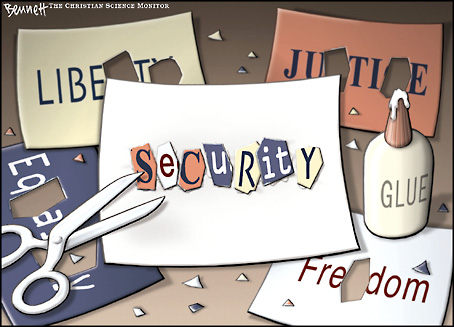
Homeland Security comes at a cost CARTOON: Clay Bennett / The Christian Science Monitor
Capital punishment is a practice that has become a common theme in history books. Execution was used by ancient civilizations with a much different rule book. Since back then laws pertaining to humane treatment of prisoners and human rights were not in place, execution was often cruel and painful for the person being put to death. However, today we are a much more civilized people and now realize that these methods are wrong, leading to most developed countries ceasing these harsh practices, and now lethal injection is the method of choice. However, the practice of killing others for their crimes is still wrong, and it should not be advertised that the answer to violence is more violence. In addition, nowadays, the racial ratios of people receiving the death sentence is unproportional towards minorities and people without the financial ability to fight their accusation, and this is extremely unfair and unjust. Capital punishment should not be legal because it is inhumane and often a result of racism and economic status, rather than a reflection of the crime committed.
Some of the ways in which we are killing people are inhumane. While lethal injection is the primary method used in the U.S., some states use less humane secondary methods. According to the National Conference of State Legislatures, other states use methods such as lethal gas, firing squad, electrocution, and hanging. Using these methods to kill people is not right because even though they might have commited a crime, they do not deserve to die a painful death. The most humane method, lethal injections, is the most popular mode used, but a considerable number of methods used are not as humane, like electrocution, firing squad, etc. These methods all need to be outlawed, and the only way for this to happen is for Congress to make laws and states to make laws to change this.
Another issue with capital punishment is the racial and socioeconomic implications it bears. In the United States, the number of people who have received a death sentence is unproportionately minorities and those living with little money. People of color are more likely to be given a death sentence than a white person, and if a white person is the victim of the crime, the defendant is more likely to be sentenced to death. If a person of color is receiving death as punishment while a white person gets to live when they committed the same crime, then it is clear that there is a major flaw in our judicial system. Another problem is that crimes with white victims are more likely to result in a death sentence. According to the ACLU, “as of October 2002, 12 people have been executed where the defendant was white and the murder victim black, compared with 178 black defendants executed for murders with white victims.” This shockingly unproportionate statistic is proof of how the judicial system favors the white race heavily. Because of this favoritism, minorities are being killed in numbers much higher than for white people. The ACLU also mentions that in the states that capital punishment is still legal, “approximately 98% of the prosecutors are white.” Our broken judicial system is killing many more minorities than white people, and the people who have control over who receives capital punishment are white. This set-up is an invitation for racism and injustice, and it cannot be allowed to continue in this manner.





 E110 FA19 Class Blog
You must be logged in to post a comment.