The “Powers” of this Poster

This is a poster for the film Austin Powers. Pictured on the poster is Mike Myers’ titular character, Austin Powers. This poster, while not very complex, does a great job of summing up the essence of the film. Like the film, the poster is fun, colorful, and just makes you smile.

One of the main elements of this poster is its use of color. The shades of red, yellow, and orange that appear in the background are fun colors. They put the audience in a happy mood. This is perfect considering the movie is a comedy and aims to have the viewer in that exact type of mood. The blue color of the title, tag line, and outfit all match. This creates a sense of unity on the poster. Your brain automatically associates all three blue things with each other. Usually, the color blue is associated with sadness. On this poster, it is not the case though.

Analyzing the Austin Powers on the cover, you can already see what type of person he is. He clearly is a very happy person. He is seen smiling and doing some sort of obscure dance move. This also portrays his sense of confidence. He doesn’t care what you might think about him or his sense of style. His sense of style is clearly outdated. By reading the tag line at the bottom of the poster, you can tell that he is from 1960’s. This sort of velvet jacket might have been more widely accepted back then. The viewer can also tell from the tag line that Austin Powers will be brought back in the 1990’s. Although not that far apart, the two decades were very different times.

The words in the background of the poster really give the audience a sense of Austin Powers’ 60’s mentality. Words like “groovy” and “saucy” were words more commonly used in the 60’s. Someone in the 90’s most likely wouldn’t be using those words. Austin Powers, like many people in the 60’s, was a free spirit. Everything about this poster, from the font of the letters to Austin’s appearance convey this message.

In the end, this poster achieves it goal of creating a fun mood that gets audiences intrigued. This poster is very minimalist compared to posters one might see today, yet is very effective at doing what it aimed to. From this poster alone, the viewer can tell that Austin Powers will be a fun and goofy movie.

Mass imprisonment in the black community- legalizing marijuana.

There is a mass imprisonment epidemic taking place across the United States. From the War on Drugs era on, the black community has fallen subject to systematic racism and prejudice implemented within American society, leaving them as the main victims of the growing incarceration rates for mariajuna related drug arrests and charges. In our nation’s capital, Washington D.C, a black man in 11 times more likely than a white man to be arrested for public consumption of marijuana (Drug Policy Alliance, 2018). 11 times more likely, yet evidence shows that black and white people use marijuana at similar rates. Further research into the ongoing drug war indicates that African Americans comprise 14% of regular drug users in the United States, yet are 37% of those arrested for drug offenses and 56% of those incarcerated for drug crimes (Rivers, 2019). Statistics such as this one clearly display the discrimination carried out by the law system when carrying out marijuana related arrests and incarceration. So the question still stands, why hasnt marijuana been legalized? 

The debate over the legalization of marijuana has been driven by the argument that legalizing marijuana would significantly decrease arrest and incarceration rates, which would help the black population escape this mass imprisonment epidemic. A statistic from politician Cory Booker highlights that in 2017, more arrests were made for marijuana poession compared to the number of arrests made for rape, aggravated assault, robbery, nonnegligent manslaughter and murder collectively (Kertscher, 2019). Marijuana arrests now constitute nearly half (45%) of the 1.5 million drug arrests annually, and an estimated $4 billion is spent annually on the arrest, prosecution and incarceration of marijuana offenders (King, Mauer, 2006). 11 states have legalized marijuana, and 3 of which (Alaska, Washington D.C, and Oregon) have reported a drop in arrest rates by 90%. This statistic shows one of the many benefits of legalizing marijuana, the funding necessary for arresting marijuna offenders would greatly decrease, as well as just the amount of arrests as well. 90% is such a significant number in terms of dropping arrest rates, and a number like this would be extremely beneficial in fighting mass imprisonment for the black community for marijuana charge

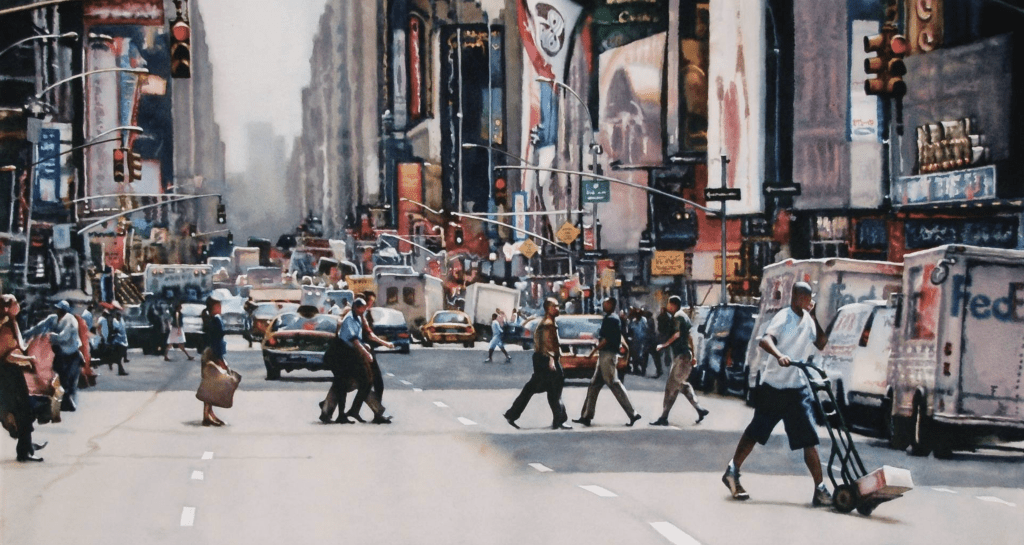
Busy in NYC

The painting “Busy in NYC” by artist Karen Frey, illustrates the atmosphere of New York City and specifically Times Square. This piece of artwork shows a popular scene in New York City, with huge masses of people crossing the street. There are streetlights, big buildings, signs, and automobiles filling the background of the picture. By analyzing the strategies used to illustrate this picture, the viewer can understand what the artist’s message and intention were when creating this beautiful work of art.  

The audience of this painting is people all over the world. Frey painted the simple characteristics of NYC that are known to everyone like the streetlights, big buildings, and cars. However, to really understand the energy and feel of NYC, you need to be there to experience it. The artist used specific artistic strategies to recreate that specific feel you get from walking the streets of the city.  

The artist’s use of color is important to pay attention to. The painting is water colored using mostly greys and a plain color pallet at first glance. However, when the painting is viewed in more depth, the viewer can see that the artist used bright colors to accentuate smaller details. The artist’s subtle use of colorful people and small details helps express her message that people in New York City are so busy and unfocussed on their surroundings. If people focused more on what goes on around them, they will notice little things they never did before.  

A strategy that was employed when painting this image was position. The viewer is watching the people as if he/she is one of them in the painting. Also, the buildings and objects look huge and overwhelming. The people look very small compared to the city itself because there are so many of them and the city is so big. The crowdedness and business of the whole atmosphere is extremely apparent. In the background, you can see trucks and streetlights and advertisements. The viewer can see that these details are there, but it is difficult to make out each object individually. They are all bunched together into an overwhelming fusion of the everyday culture in New York City that involves crowds, chaos, and an environment unlike any other in the world. This positioning highlights the artist’s intention to express the chaos and energy of New York City. 

Finally, the symbolism of the details in the painting help convey the message. When you look closely at each individual person, they are all very detailed and different. There is a man delivering a package in shorts and a t-shirt. There is a businesswoman holding a large bag. There is a garbage man. There are also people in casual everyday attire who are also simply going about their day. Although all these people are crossing the same street together, they are all only paying attention to themselves and not connected with the people just feet away from them. The huge size of New York City allows for huge masses of people to be closely pushed together, but more importantly creates an isolated and self-oriented lifestyle. People are so focused on where they are going, what they need to do, and their daily routine that they forget to stop and pay attention to their surroundings and realize the events and occurrences in the world right in front of them. 

The Fine Line

Harry Styles. He grew up in the eye of the public, constantly changing with age. From the time he was an immature sixteen year old singing pop songs in a boy band, to where he has ended up as a mature music artist who has broken so many social boundaries, the evolution he has had as an artist and as a person is undeniable. After huge success in beginning a career as a solo artist with his self titled debut album in 2017, Harry Styles, Styles has recently announced the upcoming release of his new album, Fine Line. In announcing this news, the image of the album cover was also released. The cover has many different potential interpretations and has been heavily investigated by different media outlets in order to try and make sense of this album cover’s meaning. 

The main idea that Styles wants to convey in his album cover is all about challenging traditional norms of gender and culture. On the cover, Styles’ outfit was very different compared to something that a typical male would wear. He wants to let people know that you do not have to wear what people want you to wear in order to be happy or find success because look at him, he is thriving and he is just wearing whatever he wants. The album title “Fine Line,” is really what captures the idea as a whole. Styles is making it known that the line that differentiates femininity and masculinity is beginning to thin, so why care what the difference is? Also, his facial expression is something to notice also. The shocked look he has almost comes across as a sarcastic tone to all of the people that critique his style, saying “Oh I’m not supposed to wear this? Oh well!”

Going back to the idea of the “Fine Line,” the colors on the cover are blue, which typically represents males and masculinity, and pink, which typically represents females and femininity. He is getting at the idea that those genders are simply represented as colors and they can be in close proximity with each other and still be great. The two colors are beginning to mesh together and sure from the surface there is a difference between them, but when you look deeper, it is just a color, and it does not matter which one you choose to identify with more. Everybody has the capability to be represented by both colors.

 Harry Styles over time has developed to be an icon for the sole reason he has broken so many boundaries in the industry. With his latest album cover release, he truly wants audiences to get a sense that it is a good thing to challenge tradition and expectations and not do things just because societal norms tell you to do so. The line is diminishing as we continue forward, let us embrace that fine line.

Image Analysis: Midol

i chose to do an image analysis of a vintage 1970’s ad for Midol, a pain reliever specifically marketed for menstrual cramps. The picture on the ad is of a young man, with the words “Your Guy: Your No.1 Reason for Midol” underneath. My immediate interpretation of the point this ad was trying to get across was this: the reason women should take Midol is not to relieve the pain of their period cramps, oh no. Women should take Midol so that they don’t give their husbands a headache from their constant whining about how much pain they’re in.

While this ad is quite blatantly sexist by today’s standards, in 1974 this was fairly commonplace. The feminist movement was just catching on at this point, so most people weren’t exactly “woke” yet. The culture at the time was that women were homemakers, men were the breadwinners of the family, and wives always put their husbands first before themselves. This is why this ad would make sense at the time.

It’s only in the teeny tiny print at the bottom of the ad that they mention the actual effects of taking Midol. Even then, their closing statement is “when you feel good, you’re good to be around. So use Midol. You’ve got a beautiful reason.” Because pain relief is not a legitimate enough reason, apparently. The only real reason you’re taking Midol is so that you yourself don’t become a pain. 

Image analysis

The picture I chose is a person holding a book. Although it seems like it is just a person holding a book, it’s not. It has much more meaning to it than that. It has many characteristics that seems to be able to interpret a lot of different things. The first thing that my eyes attract me to is the hands that holds a book. The most important quality in this picture would be the book probably. One idea that I have about this picture is that the person who is holding the book is a priest and the book is a bible. The way that the person holding the book seems pretty spiritual like the way a priest holds a book. It could be a priest preaching in a church and religion and God is coming out of the book. Although the book doesn’t really look qualified to be a bible. I think that because it is too skinny to be a bible, and too long in wideness.

            This picture could just also be a woman or a man who is looking at a recipe book and trying to cook. In the background behind the hands looks like the person is possibly wearing an apron. And the glowing part that takes up most of the picture is the flour because the cooker is pretty bad at cooking. There are so many things that you can interpret this picture into.

            Although there are many things you can make of this picture, it isn’t always just about the actual things that you see in the picture. What I mean by that is you can interpret the picture in a much bigger way that cancels out all of the theories to what this picture really is about. The big idea of this picture is very powerful that some people may not understand. The big picture (no pun intended) of this is the power of knowledge. What I mean by this is that the person who created this picture is trying to describe knowledge in a picture. By reading books, you acquire knowledge. The light coming out of the book is the knowledge and power you receive from books.

Can LSD and Mushrooms Help Mental Health?

Before doing any research, I had previously believed Lysergic Acid Diethylamide, LSD and Psilocybin mushrooms, were recreational drugs that were taken by hippies and Grateful Dead fans in the sixties. I believed it was a way for people to escape reality. However, after researching, it was apparent to me that people used this drug for other reasons than just to get “high”. Many people take very small doses of these drugs to benefit their mental health. This procedure is caused micro dosing, and there are many studies that show the positive results of doing this. Two studies done by Megan Webb, James Fadiman, and Sophia Korb tested the effects of micro dosing on a controlled group of people. The results show that micro dosing can benefit mental health in a variety of ways: enhance mood, increase creativity, help depression and anxiety, help people overcome addiction, replace anti-depressants and prescribed stimulants, increase confidence, and help people with mental issues due to physical problems in participants. 

Some participants in Webb’s study reported quitting heroin, opioids, alcohol, and even cigarettes due to micro dosing. One example of this is Marcus who claims, “I’ve been addicted to heroin for the past three years and I’ve also quit heroin completely, since I’ve started micro dosing,”. Another participant with an addiction to cigarettes stated that one of the first things he noticed when he started micro dosing was that he had no inclination to smoke anymore. There are also studies that show how micro dosing LSD and mushrooms can help with emotional symptoms that are a result of physical health issues. Some health issues may include cancer, menstrual cramps, or serious injuries that lead to depression. One participant named Tori in Webb’s experiment experienced a really bad brain injury that left her feeling unlike the person she was before the injury. She said starting to microdose made her feel how she felt before the injury, and that it really benefitted her mental health. Another example is that A participant in Webb’s study was experiencing extreme trauma in their life due to the death of a loved one. Her name is Ashley, and she started micro dosing as a way to help her deal with grief and sadness. Ashley stated, “We had a friend die and it was just a really hard time. I mean a very hard time, it was my husband’s best friend…So I feel like it [micro dosing] helped a lot of things too, not just the goals I did have, but i feel like it made me feel better and pulled me out of a funk I was in.”

There are many common themes and conclusions that can be drawn from micro dosing. Generally, positive experiences make up 80% of micro dosing examples, and negative and neutral experiences make up the other 20%. From performing extensive research, my previous beliefs about Lysergic Acid Diethylamide and Psilocybin mushrooms have changed. When used in a controlled setting, there are shocking positive results. I believe that micro dosing could possibly be revolutionary in the medical field and should be more seriously by people in the medical field.

Mental Illness is Not the Cause of Mass Shootings

Mass shootings and gun violence are epidemics within the United States that are affecting far too many innocent people and need to be dealt with immediately. The Republican Party tends to blame mental illness for the mass shootings that occur. This theory is not only detrimental to the stigma around mental illness in the United States but also provides an excuse for a problem with a clear solution. Therefore, even though the United States has an abundantly clear issue with the stigmatization of mental illness, the real problem at the root of mass shootings is the accessibility of assault weapons and the leniency and lack of strong gun control legislation.

On Valentine’s Day of 2018, the United States saw its most fatal high school shooting. Nikolas Cruz, a nineteen-year-old who had been expelled from the school, opened fire at Marjory Stoneman Douglas High School in Parkland, Florida, where he killed seventeen students and staff members and injured seventeen others. After the shooting in Parkland, Floridian legislators raised the minimum age for purchasing rifles to twenty-one yet Congress did not attempt to make any changes to federal gun policies (Council on Foreign Relations). Twenty survivors including notable leaders such as Emma González, David Hogg, and Cameron Kasky started an organization entitled, Never Again MSD, which quickly led to the nationally recognized, March for Our Lives.

Many government officials, specifically those with a Republican affiliation, tend to use an extremely detrimental scapegoat in their reasoning behind the abundant mass shootings in the United States. They almost always claim that these shootings stem from some sort of mental illness within the perpetrator. This does not only harm the progress being made in destigmatizing mental illness in the United States. According to the American Academy of Family Physicians, this claim is ludicrous and unsupported by any scientific evidence. All this claim does is perpetuate the idea that people with mental illnesses are violent which is not true for the overwhelming majority of those suffering from mental health problems. It also provides an excuse that allows legislators to not make any progress in the fight for better gun control laws (American Academy of Family Physicians).

However, whether or not the federal government takes action in the fight for mental health reform does not change the fact that that is not the reason behind mass shootings. According to a study published by the American Psychiatric Association entitled “Mass Shootings and Mental Illness”, people suffering from mental health issues commit a diminutive percentage of mass shootings and carry out less than one percent of the annual gun homicides. In this same study, it was detailed that people with mental illnesses are infinitely more likely to be the victims of violent crimes than the perpetrators. According to C-SPAN, in the press briefing following the shootings in El Paso, Texas, and Dayton, Ohio on August 3 and 4, respectively, President Donald Trump cited “mentally ill monsters” as the reason for these acts of violence. Many psychiatric specialists outright rejected those claims. 

The American Psychiatric Association issued a statement in response that read, “It is important to note that the overwhelming majority of people with mental illness are not violent and are far more likely to be victims of violent crime than perpetrators of violence. Rhetoric that argues otherwise will further stigmatize and interfere with people accessing needed treatment.” 

According to psychiatrist Amy Barnhorst, MD, the reasons behind this outlandish theory that is pumped through the media is likely a means of understanding an intangible idea and senseless act. Barnhorst told MedPage Today:

It’s hard for people to understand why they would have done it and they want to come up with some explanation. Many people don’t really understand what mental illness is, they just think it’s a problem with your mind. They think [a shooter’s] mind must not be working, and that’s why this happened. This further feeds into the stigmatization of mental illness and the lack of mental health education in the United States (MedPage Today). 

This quote details that blaming mental illness for these incessant shootings serves as nothing but an attempt to deflect attention from the real issue at hand: the easy accessibility of firearms and the lack of strong gun control legislation. The United States’ gun ownership legislation all stems from the Second Amendment which states, “A well-regulated Militia, being necessary to the security of a free State, the right of the people to keep and bear Arms, shall not be infringed.” While there are still some restrictions on the process of obtaining firearms, the Supreme Court has rolled back its decisions on some restrictions. For example, in 2008, the Supreme Court stripped Washington, DC of a law that banned handguns. In January 2016, President Barack Obama began to take many steps in order to decrease gun violence. These included making it a requirement for firearm dealers at gun shows and online to receive federal licenses as well as to conduct background checks. However, even though some small steps have been made in the right direction, there is not close to enough being done. According to the Council on Foreign Relations, as of 2019, there are no federal laws banning semi automatic assault weapons, military-style rifles, handguns, or large-capacity magazines in the United States. The United States accounts for roughly five percent of the world’s population yet holds 46 percent of the world’s civilian-owned guns. Not only does it house the most civilian-owned guns it has the highest amount of firearms per capita and the greatest homicide by firearm rate of all the world’s developed nations. Yet organizations like the National Rifle Association who profits like to claim that these statistics do not present a direct relationship. The United States has a serious problem with gun violence that other developed countries do not deal with to such an extent. 

The Christchurch mosque shootings were two chronological terroristic shootings at mosques in Christchurch, New Zealand on March 19, 2019. One day after the first victims were memorialized, Ardern announced a national ban on all semiautomatic weapons, all high capacity ammunition magazines and all parts that allow weapons to be modified into the kinds of guns that carried out the Christchurch attacks (New York Times).

Mass shootings within the United States are very frequent and barely any legislative change is ever made as a result of them. However, after almost each tragedy, legislators extend their thoughts and prayers and constantly fail to implement any sort of legislation to put an end to this horrendous cycle. The lack of legislative change on this topic can be attributed to a few major reasons. Members of the Republican Party often sound like broken records after each mass shooting, always citing the same reason for the mass shootings: mental illness. This is a scapegoat that pushes the misinformation that those suffering from mental illness are violent and are at the helm of mass shootings even though that theory is constantly discredited by notable psychiatrists and psychological professionals. This theory that has no credible evidence is detrimental to the stigma around mental illness in the United States while also providing an excuse for a problem that has a clear solution. The United States Congress needs to pass laws that call for stricter universal background checks and a ban on assault weapons, for example. So, therefore, even though the United States has an abundantly clear issue with the stigmatization of mental illness, the real problem at the root of mass shootings is the accessibility of assault weapons and the leniency and lack of strong gun control legislation.

children and sleep

Sleep is very vital towards the overall health of a person. Now imagine how important sleep would be for a young child. Sleep patterns are developed at a very young age and it is important to maintain good patterns as children grow up. Children and their development have been researched for many years and more discoveries have been made. In this paper, I will research the connection between young children and sleep and how it affects their academic performance. Through this I also look into the effect of socioeconomic status effect and exposure to TV’s effect on sleep. The amount of sleep a child gets will determine their academic performance in school and some of the factors as well.

One of the effects on sleep in early childhood is socioeconomic status. Socioeconomic status is defined as “a combination of income, education, and occupational demographics” (Marco, Christine A, pg. 2). These different types of statuses have effects on sleep in early childhood. According to the article Exploring Socioeconomic Differences in Bedtime Behaviors and Sleep Duration in English Preschool Children, Sleep hygiene behaviors… were more common in the high socioeconomic status compared to the low socioeconomic status group (pg.1). Sleep Hygiene are the certain sleep behaviors like regular bedtime, reading at bedtime, and falling asleep in bed and they are commonly recommended. Some of the parents in the lower socioeconomic class couldn’t practice proper sleep hygiene due to difficulty, inability or inconvenience. 

It is very important that any person regardless of age is able to get a proper amount of sleep. This sleep is very vital to young children since their brain is still developing and need these proper habits. Children need to start creating good sleep habits in order for their brain to function and then prepare for school performance. 

image analysis

The image I chose includes eight women in their undergarments posing for a photo. All the women are representing different body types and sizes seen all over the world. The women in this photo are smiling, happy, and seem to be feeling confident. This image was created in the hopes of creating body confidence in the millions of impressionable women and kids all over. Throughout history, body shaming has been very prevalent, shaming women for not fitting the mold of the perfect body. Being tall and thin was what was expected of women and represented the “perfect” body. This is a message to society showing how people can defy the cultural norms it provides. There is no perfect look, everyone is perfect in their own, unique way. 

            There are many things in this image that represent the message with one of them being color. All the women in this photo are wearing undergarments full of color. The color in this photo represents confidence which is very important for loving who you are. All the women are wearing bright colors which represents the happiness in who they are.  Another thing about the color I noticed was that all the women are wearing different colors. The different colors represent how each one of these eight women are different from each other and how everyone is different. Another thing I had noticed in the image was that all the girls are different heights and skin tones which represents all women all over the world. The target audience of this photo is teens and women struggling with their body image. Teens are very impressionable people and can be easily persuaded by the media. It is important that teens are seeing more images like this one so that they don’t develop body image issues. Body image issues in teens are very hard to shed and can lead into adult life. Seeing images like this one will show that every body type is beautiful and that you don’t have to live up to the standards the media presents. 

A group of people posing for the camera

Description automatically generated